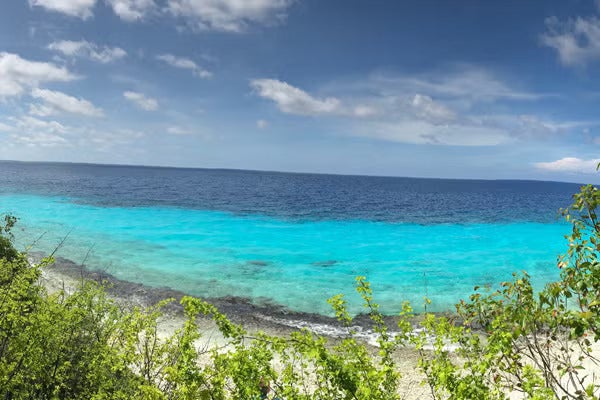
Adiver’s paradise with pristine blue waters is located in the Caribbean Sea around the small Dutch island of Bonaire. With a population of about 20,000 people on 112 square miles of island, Bonaire is almost twice the size of Washington DC and lies about 50 miles off the coast of Venezuela. The island has an impressive record of protecting its natural environment and resources. These efforts have interlaced themselves with the residents’ everyday life and the fabric of Bonaire’s culture. Bonaire enjoys an international reputation for some of the world’s best ocean activities. The island is a trailblazer in the Caribbean, developing a protected marine park in the 70s. It also began a desalination process to extract drinking water from the ocean, and continues its ongoing conservation methods to protect and conserve its marine life.
Known as a Blue Destination, Bonaire is true to its history, heritage, economy, and livelihood. According to Commissioner Elvis Tjin Asjoe, “Bonaire as a Blue Destination repositions the island in the Caribbean region, and the world, as a progressive and transformative island closely attached to a sustainable economy that protects its natural resources, the environment and its culture. The Blue Destination concept also means a lifestyle comparable to the prudent and responsible use of ocean resources for the benefit of Bonairians and future generations.”
A direct result of the Blue Destination plan is the collaboration with the European Union to promote projects focused on resilience, sustainable energy, and marine biodiversity. A UCF Rosen College of Hospitality Management research team pioneered the concept of a Blue Destination in the Caribbean as a result of a research assignment commissioned by the Bonaire government. The research team crafted the tourism master plan for the island entitled Tourism: Synergizing people and nature for a better tomorrow. The Blue Destination concept derives from the Blue Economy program from the United Nations and other international organizations like the World Bank. A Blue Destination is anchored on the UN’s Sustainable Development Goal (SDG) 14, which encourages the responsible use of ocean resources intertwined with eco-friendly “green codes.” Ever pioneering, Bonaire was the first island in the Caribbean and the world to embrace the Blue Economy concept.
In December 2016, the Tourism Corporation Bonaire (TCB) commissioned the Dick Pope Sr. Institute for Tourism Studies at UCF Rosen College to develop a Strategic Tourism Master Plan 2017-2027. At that time, the TCB felt the destination was at a critical crossroads. The central questions were how to make the tourism industry sustainable now and for the future, and how to optimize the participation of residents in the benefits that sustainable tourism could afford to them.
The UCF Rosen College research team met with more than 200 stakeholders faceto-face to conduct formal and informal interviews. The team also crafted seven surveys and administered these from March to July 2017. Nearly 3,000 respondents completed the seven survey questionnaires. The respondents included stay-over tourists, cruise tourists, Caribbean tourists who had never visited Bonaire (i.e., latent demand), tourism employees, and the local population. The research team also organized two summits on the island with all stakeholders, adopted the use of “big data analytics” on nearly 11,000 ED cards and evaluated over 3,200 comments from TripAdvisor and online traffic statistics for the TCB website.
Bonaire has led the Caribbean in conservation efforts since the 1970s. Creating a legal framework for Blue Conservation will continue to place Bonaire as the leader of conservation efforts in the Caribbean. This entails choices such as banning oxybenzone (an additive found in sunscreens), plastic bags and plastic straws, and awareness programs championing the prudent use of ocean resources. The tourism master plan mainly embraced two sustainable development goals: SDG1 (poverty elimination), and SDG3 (well-being promotion).
Commissioner Tjin Asjoe reflected on his experience working with the UCF Rosen College research team, indicating that the study has already impacted the local tourist industry and is showing its relevance for the whole island society. “What has impressed me working with this team is that there were clear measurements to assess the progress of implementation,” said Tjin Asjoe. “These measurements are relevant for our quality of life and are important for our hospitality businesses. Opportunities, choices, and business yield are what we are looking for, and they are closely related to our lifestyle and way of thinking.”
The UCF Rosen College research team consisted of Drs. Robertico Croes, Manuel Rivera, Kelly Semrad, Valeriya Shapoval, and Mathilda van Niekerk. Dr. van Niekerk passed away during the implementation of the plan.