The average American spends 46% of their weekly food budget on dining out in restaurants. This may be good news for the food service industry, but it is concerning for public health. Large portion sizes and unhealthy dishes, which are often available to us when dining out, are associated with a number of serious health conditions, including obesity and diabetes. Obesity in particular is a major cause of mortality in the United States, accounting for a staggering 18% of all deaths. Following a healthy diet and lifestyle is therefore crucial to reduce the risk of chronic illness. Having access to our food’s nutritional information when dining out is now more important than ever.
As well as maintaining a healthy diet, many Americans have specific dietary requirements. Around 30% of Americans have specific dietary preferences, 20% have food sensitivities, and 5% have food allergies. Dining out can be challenging for people with dietary requirements as appropriate dietary information may not always be readily available.
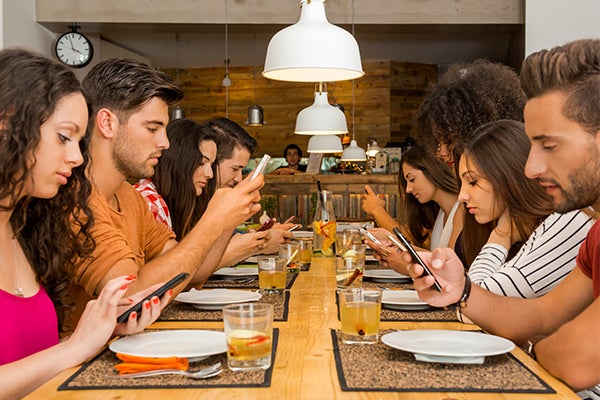
Smartphone diet apps can offer an appropriate, convenient, and cost-effective means for displaying nutritional information and weight-control interventions. These apps can assist customers to make more informed decisions when ordering food or selecting a restaurant by providing accurate nutritional information.
Several apps have been designed to assist with healthy eating and food choices, including Fooducate, Restaurant Nutrition, Zestar, MyFitnessPal, and HealthyOut.
There has been a lot of research focusing on new and innovative technologies to develop nutritional smartphone apps, yet there has been a comparative lack of research investigating how users’ beliefs and attitudes towards smartphone diet apps affect their food selection and consumption.
PSYCHOLOGICAL FACTORS AFFECTING DIET APP USAGE
Bridging this gap, Rosen College researchers, Dr. Bendegul Okumus and Dr. Ahmet Bulent Ozturk, have conducted a study to investigate psychological factors that influence users’ acceptance of smartphone diet apps when ordering food and beverages in restaurants.
This study builds upon some of their previous research by using a more up-to-date and integrated theoretical foundation, called the Unified Theory of Acceptance and Use of Technology (UTAUT).
Using this UTAUT theoretical foundation, the Rosen College researchers proposed four initial determinants of mobile diet app usage: performance expectancy, how much the user believes that the smartphone diet app will actually improve their diet; effort expectancy, how effort-free the user believes the app will be; social influence, the extent to which the user perceives that the relevant people believe they should use the app; facilitating conditions, the extent to which the user believes there exists an appropriate technical infrastructure to support the use of the system, e.g., to install and configure the app. The researchers also propose a fifth and final determinant in users’ acceptance of smartphone diet apps – personal innovativeness, the extent to which the user is receptive to new ideas and makes innovative decisions.
The Rosen College researchers chose to use the popular MyFitnessPal smartphone diet app to investigate individual determinants of app usage, and they asked participants to fill out questionnaires to measure performance expectancy, effort expectancy, social influence, facilitating conditions, and personal innovativeness.
Using advanced statistical techniques, Dr. Okumus and Dr. Ozturk’s research showed that performance expectancy, effort expectancy, social influence, and personal innovativeness were all determinants of smartphone diet app use. Therefore, the results of the study suggest that users will have positive intentions to adopt smartphone diet apps if they are perceived as easy to use and able to improve their dieting, especially if there is influence from users’ social circles or if a user has an innovative personality.
Although Dr. Okumus and Dr. Ozturk thought that facilitating conditions would also determine intention to use smartphone diet apps, this did not in fact prove to be the case. The researchers suggest that this may be because of recent increases in smartphone use that took place when this study began in 2015, leading to people feeling more familiar with smartphone apps and less concerned about facilitating conditions.
Deeper investigations into the results of the research revealed that social influence was the highest predictor of intentions to use smartphone diet apps when ordering food at restaurants. This suggests that social influence should be a key factor to be taken into consideration by diet app developers. For instance, apps can be designed to allow users to compare their diet and health progress with friends and family members.
After social influence, performance expectancy was the next most significant predictor, followed by personal innovativeness, and effort expectancy. In relation to app development, this suggests that diet apps should be carefully designed to ensure easy navigation and understanding, and to avoid user confusion and exhaustion. Promotion and communication campaigns can also be highly effective in increasing the adoption rate of diet apps by innovative users.
AGE AND GENDER DIFFERENCES
Furthering their investigations, the researchers also investigated whether there were any differences in the use of smartphone diet apps between males and females, and younger (18–34 years old) and older people (35+ years old).
They found that there were no differences in effort expectancy and personal innovativeness between males and females, but they did find that the effects of performance expectancy and social influence were far stronger for males than females. The researchers suggest that this may be due to males perceiving smartphone diet apps as more useful and valuable in managing their diet, than females.
In contrast, the researchers found there were no differences in intentions to use smartphone diet apps between older and younger people. The researchers suggest that these findings are not surprising. They argue that, although there is a stereotype that older people do not adopt technology as quickly as younger people, research suggests this is not the case and that a large proportion of older people use technology regularly.
WHY IS THIS RESEARCH IMPORTANT?
Americans are becoming more health conscious, and with this comes higher demand for healthy eating environments. Customers are often more willing to visit and have a more favorable attitude towards healthy eating restaurants if they are provided with nutritional information. Therefore, the knowledge of which factors determine usage of smartphone diet apps uncovered by Dr. Okumus and Dr. Ozturk’s research could inform the development of diet apps, thereby improving their usability, leading to greater customer engagement with nutritional information and potentially healthier eating behaviours.
Understanding the psychological factors that shape users’ intentions for diet apps is crucial to inspire individuals to use nutritional information in their dietary choices. Hospitality and foodservice businesses already use certain smartphone apps, such as Event, One Table, Airline Apps, and Uber. However, none of these mobile apps provide detailed nutrition, health and/or food information for users. Dr. Okumus and Dr. Ozturk’s research could be used to inform the development of a user-focused diet app, based on the psychological factors which determine its use.
The development of user-focused apps could be adopted by restaurant businesses to increase custom and customer satisfaction. Smart apps could inform their patrons about composition of ingredients, such as organic, non-GMO, vegan, vegetarian, pork free, gluten free, or other special diets. Such mobile apps can provide quick and detailed information to the user even before visiting foodservice businesses. They are also a cost-effective marketing tool for the products and services of the business.
Most critically, US restaurants are not required by law to provide nutritional labeling of their products. Therefore, people with specific dietary requirements or following a healthy lifestyle, may not be able to access the necessary information about their food. Diet apps, with a focus on performance expectancy, could provide the necessary information for the user’s specific dietary needs.