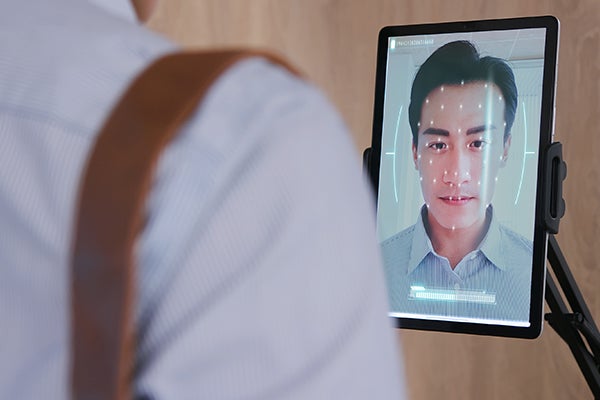
You might have come across facial recognition as a security feature on your phone or laptop, or even at passport control in an airport, but have you ever checked into a hotel via facial recognition on the front desk? The use of facial recognition check-in services in the hospitality industry is a relatively recent, and still uncommon, use of the technology, which until now has been more commonly utilized on personal devices. It has been suggested that such systems will enable hoteliers to speed up delivery of services and, therefore, strengthen their customer relationship in several ways. According to recent research, intelligent check-in can reduce check-in time by two-thirds, massively improving efficiency at hotel receptions. However, such technology does not come without its drawbacks, and in this case, without a large helping of public concern. The general public’s trust of biometric technology in such contexts is still relatively untested, and although it has been argued that people’s data is safer and more secure in such a system, data security and privacy are issues that remain high on any list of customer concerns.
Dr. Tingting Zhang, Associate Professor at Rosen College, is currently carrying out research directed towards a better understanding of customer engagement in the hospitality and tourism industries, with a special focus on technology usage and adoption. She and her collaborators recently conducted a study investigating how the customer’s perception of security, privacy and trust impacts the adoption of a facial recognition system at hotel check-in. By examining the positive and negative experiences (or lack of experience) of over 300 real hotel guests with facial recognition systems, Zhang was able to empirically assess their perceptions of security, privacy and trust.
EARNING OUR TRUST
For this investigation, Zhang and her collaborators have defined security, privacy and trust as follows: security is the protection of data to prevent destruction or unauthorized access; privacy is the way in which a customer’s private data is collected, stored and used; trust is the set of beliefs held by consumers about a service supplier. Both perceived security and perceived privacy have an influence on trust. Research has previously reported that customers rank security features above privacy features, because without effective security, privacy is impossible. Additionally, the literature shows that customers also rank security as their priority (over privacy and convenience) when it comes to biometrics, but some travelers are happy to trade some level of privacy for easier check-in and security benefits.
This study is important for three key reasons; firstly, considering the low level of application of this technology in hotels, this research will add to our understanding of how users experience biometric technology in hospitality literature; secondly, although security, privacy and trust have been covered didactically in the literature already, there are few studies in this particular context (hotel services facial recognition); and thirdly, this study considers users’ prior experiences of technology adoption, expanding the understanding of how prior adoption affects current decisions.
PRIVACY OVER SECURITY
In order to find out how a customer’s perceived security, privacy and trust affects their willingness to adopt facial recognition technology at the hotel front desk, Zhang and collaborators designed a questionnaire. The first part of the survey focused on the participant’s prior experience of the technology, and their intentions regarding adopting it. The second part of the survey measured the perceived security, privacy and trust of the facial recognition system. The final part gathered demographic data about the participants, as well as details of their most recent travels. The study was conducted amongst a Chinese population in central and southern China between October and November 2018, as the technology has already been adopted in some areas of the hospitality sector there.
The results from the questionnaire confirmed that perceived security, privacy and trust in a facial recognition hotel check-in system significantly affected willingness to adopt them. The higher the participants’ perceived security, privacy and trust, the more willing they were to use facial recognition technology during check-in. Interestingly, and contrary to prior investigations, when the customer perception of privacy was greater than the perceived security benefits, trust was overall enhanced, but when concerns relating to the privacy of the system were greater than the security benefits, trust in the technology was greatly decreased. Zhang suggests that this may be a result of an already well-established trust in Chinese security in this context, leading to the higher concern for people in this study being privacy (i.e. how the hotels and third parties will use their information, and how much of it was collected). She suggests that this demonstrates a need for service providers and governments to reassure users about the privacy of the information provided in order to gain their trust. The survey responses also confirmed that those who have previously had a positive experience of a facial recognition check-in service had higher perceived security, privacy and trust in the system than those who had a negative experience or no experience at all.
FACING THE FUTURE
What do these findings mean for other academics in the fields of technology and hospitality management? Primarily, this study opens up a new area of research in the use of facial recognition technology in the hotel sector, providing empirical evidence of user experience. It also provides meaningful contributions to the theory of security, privacy and trust, which are the key factors affecting user adoption of such systems in hotels.
This paper is groundbreaking because of its combined investigation of the effects of inverse perceptions of security and privacy on trust; perhaps the most valuable takeaway from the paper is the revelation that when perceptions of privacy were greater than security, trust in the technology was increased, but when concerns related to privacy were greater than the security benefits, trust was lessened significantly.
Furthermore, this study contributes significantly to the field of literature on prior experience and technology adoption. Not only have Zhang and her collaborators revealed that a positive prior experience increases the chance of adoption, they have also extended the research by considering different types of prior experience (good and bad) and reporting on the effect this has, further enriching our theoretical understanding.
On a practical level, with the incidence of facial recognition check-in technology in hotels increasing, the findings of Zhang’s study are invaluable. The findings highlight how important just one experience of biometrics can be; a bad experience will decrease the likelihood that a customer will adopt the system again in the future. They also show how perceived security and privacy are critical to building consumer trust; hoteliers must, therefore, invest in robust privacy protection and security benefits if they wish to install facial recognition check-in technology. In fact, as privacy was the bigger concern for study participants, hospitality managers need to put most of their efforts into ensuring that their guests’ private data is respected, and minimizing the amount of private data that is collected in the first place. Zhang and her collaborators suggest that information on such protection and benefits should be made widely available to customers at the point of use, either as clear signage or via appointed staff. The key, she says, is to find the best methods to gain the trust of visitors. Ensuring the successful use of facial recognition check-in technology can then, in turn, lead to a more efficient, less costly way of running the hotel check-in desk.