Across the expanse of terrestrial history, a little over 4.5 billion years, Earth has witnessed periods of stability and periods of rapid and dramatic change. The periods of dramatic change include those associated with mass extinctions, during which more than three quarters of species on Earth are lost within a short (geologically speaking) timeframe (approximately 2 million years). The last confirmed mass extinction was the most famous: 65 million years ago, the collision of Earth with an asteroid marked the end of the Cretaceous Period and of the dinosaurs. Recent Earth history, the 11,700-year-long (to date) post-ice age Holocene epoch, has been a period of relative stability that has allowed for the advent of modern human beings and human civilizations. However, Earth may now have entered a new epoch, the Anthropocene. While no official recognition for this epoch has been given, human-driven climate change is almost universally accepted as fact, and early signs suggest that we may be heading towards a sixth mass extinction event. Unlike the end of the Cretaceous, earlier extinction events likely came about because of dramatic changes in the carbon cycle, probably driven by widespread volcanic activity. Today, volcanoes remain a source of carbon emissions, but their contribution is grossly outweighed by CO2 from human activities.
ANTHROPOGENIC CLIMATE CHANGE
From the Greek word ‘anthropo’ (meaning man), the Anthropocene marks the time period in which human activities have impacted on Earth to a degree sufficient to make a mark on the geological record. Some people place the start of this period in the late 1940s/early 1950s, when the testing and deployment of atomic weapons caused the deposition of radioactive particles in the soil. Others argue that the Anthropocene can be dated to the Industrial Revolution of the 1800s, before which atmospheric CO2 never exceeded 300 ppm, and since which it has risen to more than 400 ppm. The most notable impact of increasing greenhouse gases is increasing global temperatures, occurring because solar energy reflected by the Earth is absorbed by the greenhouse gas particles and re-reflected back to the surface. Increasing air and water temperatures have complex and far-reaching implications, including driving changes in climate patterns and extreme weather, altering habitats, and reducing the ice volume of glaciers and polar ice caps, in turn leading to rising sea level. Extinctions are on the rise, with one estimate suggesting that 7% of the animal species alive in 1800 are now extinct, equal to around 130,000 species.
Climate change and environmental degradation have come to define the times in which we live. Beyond the impacts on our natural world, the implications for human society are also profound and wide reaching, impacting on economics, politics, social systems, resource availability, and health and wellbeing. At UCF Rosen College of Hospitality Management, Dr. Sergio Alvarez is focused on the role of coastal tourism destinations in climate change adaptation. In particular, he argues that employing landscape-scale regeneration and green destination management strategies has the potential to turn coastal tourism hotspots into carbon sinks; that is, places that absorb more atmospheric carbon than they produce.
TOURISM IN THE ANTHROPOCENE
Taken as the early 1800s, the birth of the Anthropocene largely coincides with the birth of the modern tourism industry. Moreover, the growth and development of the tourism industry mirrors the growth and development of industrialization and globalization. As such, tourism is intricately linked with anthropogenic climate change, being both a cause of greenhouse gas emissions and environmental degradation (e.g., aviation emissions, over-development, habitat loss) and a victim of the consequences (e.g., sargassum blooms, extreme weather, sea level rise).
Some estimates suggest that up to 8% of annual global CO2 emissions are linked to the tourism industry, approximately 50% of which occurs in the coastal zone. Tourism infrastructure to support mass tourism is often achieved by clearing natural habitats and ecosystems; for example, by draining wetlands to build new developments or building roads along coastal sand dunes, damaging the dune system and exacerbating erosion. In some cases, beaches are constructed by shipping sand in from other sites, damaging the natural environments in both the supplying and receiving locations, and emitting CO2 in the process. Conversely, coastal areas also bear the brunt of climate change-driven impacts. As low-lying areas, coasts are susceptible to rising sea level. Hurricanes, which develop over open ocean, hit coastal areas the hardest. Coastal landforms are often dynamic (e.g., beaches, lagoons, sand dunes, estuaries), placing them at significant risk when the supply and transport of materials are altered by changed climate patterns or human intervention; for example, erosion and changes in sand supply.
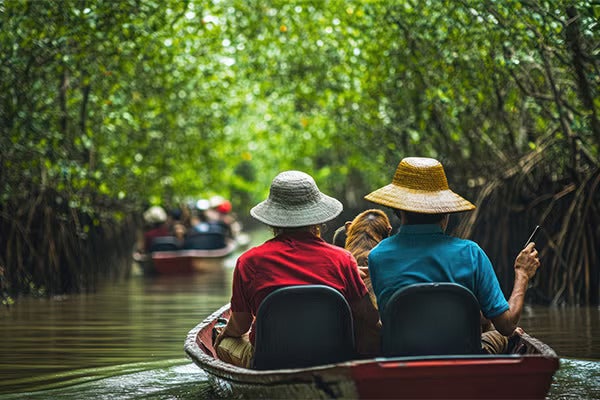
A major victim of coastal tourism development is vegetated coastal ecosystems, also known as blue carbon ecosystems, including marshes, mangroves, and sea-grass meadows, at least 50% of which have been lost to human intervention. Blue carbon ecosystems are natural carbon sinks; that is, they sequester more carbon than they produce. When they are replaced with tourism infrastructure, not only is this carbon sequestration ability lost, but excess CO2 is generated by the development of new infrastructure and long-term execution of tourism activities.
Dr. Sergio Alvarez suggests that the restoration of blue carbon ecosystems offers a cost-effective approach to not only ameliorate environmental degradation at the local level, but also to mitigate the effects of climate change at the global scale.
BLUE CARBON ECOSYSTEM REGENERATION
The restoration of blue carbon ecosystems requires three main management strategies, which together facilitate the regeneration of natural processes and native plant species in coastal areas:
(1) Reducing nutrient input to waterbodies to improve water quality. Sources of such nutrients include agricultural pollution from high-density livestock rearing and fertilizer leaching/run-off, untreated wastewater, and stormwater overflow. Better management of these sources is needed to improve the water environment.
(2) Restoring natural water flow; for example, by removing water control structures such dams.
(3) Controlling the population of burrowing animals (e.g., crabs and earthworms), which alter plant growth and carbon flows within the ecosystem. Management strategies include the protection of predators high in the food chain, such as shorebirds and fish that feed on burrowing species.
For the best results, restoration should occur in tandem with the conservation of existing blue carbon ecosystems.
However, this process is hampered by high financial outlay, including both upfront costs and ongoing costs associated with monitoring, management, and protection. Moreover, natural ecosystems provide limited scope for economic development. As such, securing funding for such ecosystem restoration projects has traditionally been challenging. One option is to harness the commodification of carbon. tCO2e (tons of carbon dioxide equivalent) are already traded via numerous schemes around the world. Companies or individuals wishing to offset their CO2 emissions can purchase tCO2e credits from carbon sequestration schemes (either voluntarily or to comply with regulatory requirements), such as blue carbon ecosystem regeneration projects. tCO2e trading has downsides, including high administrative costs, high risk investment, and risk of abuse, but nonetheless offers an opportunity for coastal tourism areas to transition from being part of the problem to being part of the solution.
REGENERATIVE TOURISM MANAGEMENT STRATEGIES
At present, selling tCO2e credits is insufficient to cover the cost of blue carbon ecosystem restoration. To address the shortfall, other sources of revenue are also needed. The tourism industry is in a unique position to offer an economically viable pathway for green coastal regeneration as it can monetize natural habitats as a ‘green attraction’, drawing in visitors who pay an entrance fee and generating additional funds via associated guiding, merchandise, and hospitality endeavours. Ultimately, the goal is to create a business model that relies on the long-term success of ecosystem regeneration; in turn, this offers the potential for long-term income generation. Partnerships with universities offer a route to long-term monitoring and assessment of the social, economic, and environmental project impacts. Ultimately, blue carbon ecosystem regeneration offers a potential blueprint for best practice in economically viable, socially responsible, green restoration tourism.