Humans are social animals; they are drawn together to share experiences. And when they do, there’s a business opportunity for providing services. This is hospitality and tourism’s very foundation, and it’s why events that gather people, whether a street performance or the Super Bowl, are crucial areas for research. However, events are more than just a fortuitous conglomeration of potential customers and guests; they are complicated, dynamic entities—no two events are the same. For this reason, research into events has reached out to include other disciplines hoping to make sense of them. It’s an area of particular interest to Dr. Michael Duignan of UCF Rosen College of Hospitality Management. After examining over thirty years of events-related research, he has revealed why we should all take a closer look.
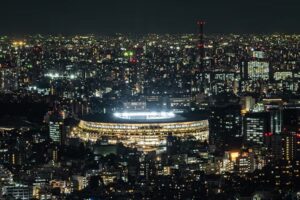
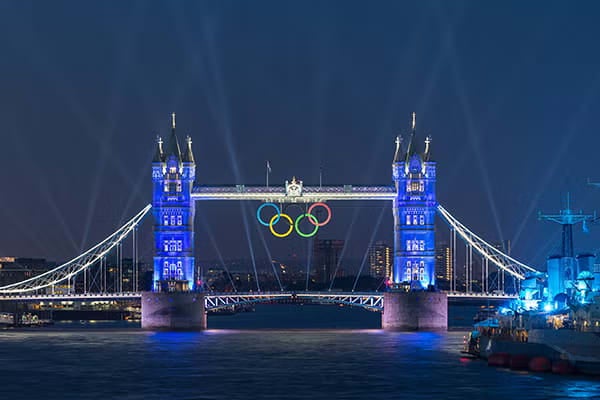
Duignan’s research into events looks beyond their economic benefits to examine their social and cultural impacts. To this end, he has traveled the world studying how hosting major events, including the London 2012, Rio 2016 and Tokyo 2020 Olympic Games—and the preparations for the Paris 2024 and LA 2028 Games—as well as the Commonwealth Games and regional sports and cultural events changes the physical, social, and cultural nature of a place, sometimes irrevocably.
Understanding such changes is critical for tourism and hospitality research. When a city pitches to host a major event, it always dangles the carrots of revenue generation, job creation, and boosting tourism—music to the ears of the sector. It points to the possible indirect and long-term economic benefits: the branding and business opportunities and multiplier effects, such as hotel staff spending at local shops. If the event is on the scale of the Olympic Games, there are added pitched benefits of infrastructure investments with legacy planning and the global media marketing of a destination’s cultural capital. But decisions around event planning can also have unintended consequences, such as social and economic displacement, negative environmental impacts, and significant risks of crippling costs and over-tourism. No Olympic host city has ever escaped unscathed.
This confluence of complexity is why Duignan is part of a growing body of leading academics across the breadth of hospitality and tourism research who are combining their insights to understand events better. Writing in the Annals of Tourism Research, he has mapped this emerging field of study by tracing the development of events-related research in that journal and the Annals of Tourism Research Empirical Insights. In his analysis, several clear trends stand out.
NO TYPICAL EVENT
It’s tempting to think of ‘events’ within the realm of tourism and hospitality in terms of large-scale experiences such as the Olympic Games, but in reality, the term’s scope is far more complex and diverse. This is one of the things to emerge in Duignan’s study. He says that if an ‘event’ is ‘any occasion where two or more stakeholders meet for a purpose, whether planned or unplanned, and typically exist in geographically demarcated and temporally tractable settings,’ it encompasses a dizzying array of permutations. He points to research into cycling competitions and voodoo shows as cases in point. Such diversity means the ‘stakeholders’ whose perspectives we should consider extend beyond governments and destination marketing organizations to include indigenous communities and vulnerable and marginalized groups. Such considerations are especially the case for events in public spaces, such as urban squares, forests, parks, and village halls. For events in private places, such as hospital conference rooms, impacts can, to an extent, be mitigated.
Events are all temporal, but they can take minutes, hours, days or even weeks. Just as the nature of an event can be difficult to pin down, so too is the impact. A street fair can boost a town’s sense of community; a major sporting tournament can be a powerful driver of an entire city’s infrastructure and destination marketing strategy. Often, the impacts of staging events continue long after the event has concluded. Consequently, Duignan points to the emerging study of field configuring events—a new intellectual domain of management and organizational studies—increasingly recognizing and seeking to capture the longitudinal value of events for advancing industrial, geographical, and social fields.
THE EVOLUTION OF A FIELD
Something else that Duignan noticed about events-related research is how conceptualizing events changed; ‘evolved’ is probably a more accurate description. Initially, events-related research focused on economic impact analyses and what motivated people to visit an event and their levels of satisfaction. Such studies helped event organizers look at how to maximize returns. However, from about 2002, events-related research began to further explore the sociological significance of events and the social implications and impacts of staging them. It developed a richer anthropological lens and a more critical eye—examining and encouraging debates around issues of authenticity, identity formation, and the impacts of events on everyday citizens regarding issues such as crime and how their cultures were represented in events.
Notably for Duignan, this shift was not a result of a vein of events-related research branching off; it emerged as the number of studies grew exponentially. As the scope of study into events expanded, drawing in researchers from different fields of study, tourism, and hospitality research was rewarded with a greater diversity of insight. It started embracing issues such as social memory and commemorative events, the contested meaning of place and associated conflicts between different representations. Paradoxically, as more and more researchers started exploring events to provide a better understanding of the concept, the more complex it became. However, one thing was evident: ‘events’ is an established field of analysis in its own right, contributing significantly to tourism and hospitality studies.
GROWING SCOPE OF INFLUENCE
By examining the events-related research in the two journals, Duignan could catalog the scope of its influence. Firstly, events-related research has provided valuable data on the economic benefits of hosting events, such as increased tourism, job creation, and revenue for local businesses, helping justify investment in events and shaping economic policies. Secondly, studies have contributed significant social and cultural insights into events, such as how they can catalyze community engagement and social cohesion—particularly important for destination branding and creating a sense of place. Research has also explored how events can be platforms for cultural exchange and understanding, enriching the tourist experience and contributing to global understanding. Thirdly, events-related research has helped guide policy and planning, especially around sustainability and risk management, helping organizers manage the environmental impact of events and ensuring they are safe for those who are part of them.
Studies into events have also contributed to innovation and adaptation within the tourism and hospitality sector. They have explored how new technologies, such as virtual reality and mobile apps, can enhance an event experience and offer avenues for improvement and development. More recently, studies focused on understanding the impact of global events like the COVID-19 pandemic on the tourism and events sector have provided guidelines for recovery and future resilience.
TOWARD A MORE THOROUGH UNDERSTANDING
Beyond the applications of such studies to the tourism and hospitality sector, there is a broader benefit to research and training organizations such as ours. As Duignan has shown, these studies have contributed to developing theories specific to tourism and hospitality. For example, theories around event leverage explain how destinations can maximize the benefits of hosting events and examine events beyond economic drivers—as temporally bound incubators and microcosms of society and social contexts. By evolving and incorporating methodologies and insights from other disciplines like sociology, anthropology, and environmental science, events-related research has enriched tourism and hospitality research overall.
Events that unite people, whether sporting, cultural, or centered around a tourism focal point, impact those who are part of it. In today’s age of social media, the tourism and hospitality sector relies on this—there’s little incentive to share something that doesn’t have meaning. Understanding what makes an event meaningful and successful must look beyond the business side of it. By examining events-related studies over the past thirty years, Duignan has not only provided a concise and fascinating synopsis of a rich, complex, and evolving field of research shaping the direction of the tourism and hospitality sector but encouraged us to, academically and operationally, take a deeper dive into it.