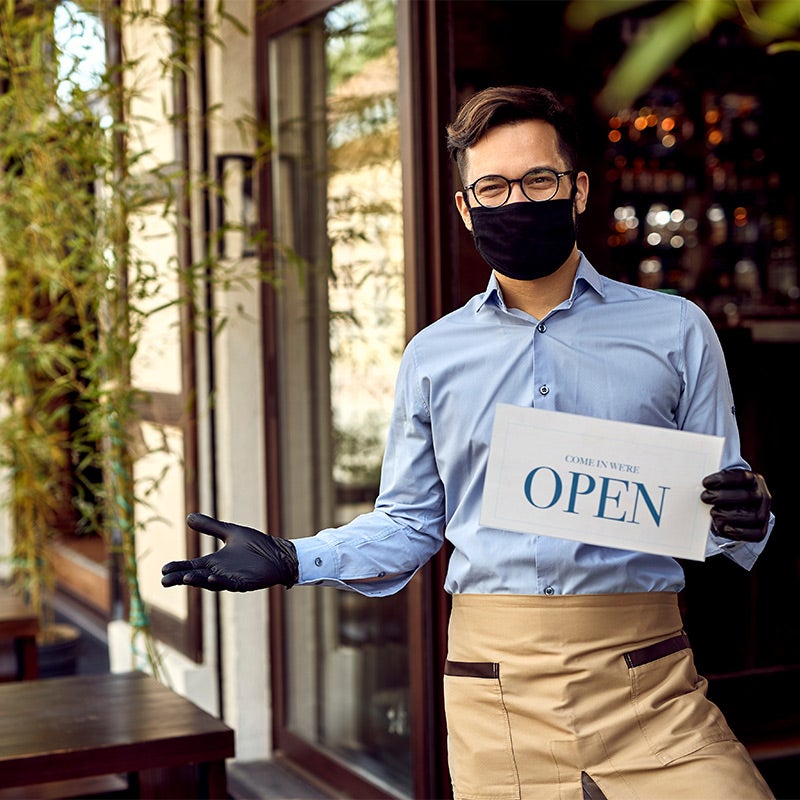
At the close of 2020, The National Restaurant Association reported that the restaurant industry was $240 billion below pre-pandemic sales estimate. Loss of business due to the COVID-19 pandemic has led to unprecedented restaurant closures, with many businesses struggling to rebuild their customer base.
Researchers have noticed these devastating effects and are keen to find ways to help the restaurant industry recover. A major area of focus is on the ‘post COVID-19 customer’. The outbreak of COVID-19 has led to consumers exhibiting extreme caution when considering dining out. Safety has now become a crucial factor in dictating dining habits, as there has been a dramatic shift in consumer behavior. In response to these changes, Dr. Elizabeth Yost and her collaborator from UCF Rosen College of Hospitality Management have undertaken research that aims to understand motivations of these ‘new customers’ in a post-pandemic landscape.
CUSTOMER RISK PERCEPTIONS AND MOTIVATIONS
Previous research has been conducted into diners’ risk perceptions, but very little has taken place during the time of a global pandemic. Risk is an important construct to research within this context because it underpins why customers have changed their dining habits. Prior to the pandemic, safety was not considered a top concern when eating in a restaurant; factors such as the ambiance, cost, convenience, food options, and cleanliness were far more important. The heightened sense of risk felt during the pandemic was intensified in restaurant settings by the concern that the virus could spread through food preparation and handling. As a result, customers have become equally as concerned about what goes on behind the closed doors in addition to front of house safety measures.
Where somebody gets their information from will also affect their risk perception, as some news outlets provide polarizing views on the validity and danger of the COVID-19 pandemic. If a person believes that the risk is genuine and could be spread through food consumption/production, they may well choose to avoid restaurant settings.
STUDY AIMS AND DESIGN
An important feature of the research was to place the customer at the center of the study; to understand their motivations to eat in a restaurant—or not—after the pandemic. The researcher’s goal was to develop a conceptual framework which could help businesses to understand which factors are influencing customer decision making. This research is intended to help guide restaurants through the process of maintaining and rebuilding their customer base, ensuring their continued financial viability in this difficult climate.
Dr. Yost and her collaborator undertook a literature review to understand more about the constructs that shape customer motivations. They investigated these motivating factors in relation to well-established concepts such as the Affective Decision Making model, Meta-theoretic Model of Motivation and Optimism Bias Theory.
AFFECTIVE DECISION MAKING MODEL
Various factors shape a person’s individual perception of risk, including their social and cultural backgrounds. Previous research suggests that we are more likely to overestimate a positive outcome in a given situation—we don’t like to imagine the worst will happen to us! This theory forms the basis of the Affective Decision Making Model (ADM), which the Rosen research team defines as a ‘behavioral theory of choice that explains how individuals select activities under risk.’ The researchers believe that ADM can help to explain how individual behavior will be affected in a post-pandemic landscape.
ADM is governed by two types of processing: rational and emotional. Our rational processing influences the actions that we take, whereas emotional processing helps to shape and formulate our beliefs. During the pandemic, customers used rational processing to determine their risk tolerance for in-restaurant dining, weighing up positive restaurant experiences, such as excitement and satisfaction, against negative perceptions relating to the risk of infection. Additionally, emotional processing is also fundamental to customer decision making. This type of processing involves two opposing impulses: affective motivation (individuals’ tendency to minimise personal risk perception) and desire for accuracy (especially in terms of knowing the restaurant’s safety measures, for example). During the pandemic, customers’ affective motivations may drive their desire to dine in a restaurant, whilst their need for accuracy around control of the virus and restaurant sanitation processes encouraged them to stay at home. Dr. Yost and her collaborator believe ADM helps to explain why customers are seeking greater accuracy in the information provided by restaurants around their food safety procedures.
META-THEORETIC MODEL OF MOTIVATION
The meta-theoretic model of motivation provides another perspective on customer behaviors. This model was developed to take into account individual differences, with the ethos that not everyone will fit the mold of an ‘average customer.’ The meta-theoretic model accounts for how our disposition and personality traits influence our behavior within a specific environment. Previous research suggests that we all have multiple personality traits which combine in differing levels to influence our behavior and decision making; these are ‘openness to experience, conscientiousness, extraversion, agreeability, neuroticism/stability, material needs, arousal needs, and physical needs’. Therefore, it is important to identify the individual traits of customers to understand how these may influence their behavior. It has been noted that people who display a higher level of agreeableness are more likely to comply with enforced COVID-19 restrictions such as social distancing. If a person has a higher level of conscientiousness or neuroticism, the meta-theoretic model would indicate that they are also less likely to dine out during the pandemic.
The research team also suggests that this model highlights how being extroverted or introverted may impact upon motivations to dine out during the pandemic. Extroverts find it hard not to have social contact, which would be a strong motivator to visit a restaurant, whereas introverts find isolation less of an issue, reinforcing their motivation to stay at home. The study argues that, by understanding the varying personality traits of customers, marketers can be more effective in targeting audiences, sending communications which encourage people back into restaurants.
OPTIMISTIC BIAS THEORY
Customer risk perceptions may also be influenced by optimism bias, when people believe that their own risk is much lower than other people’s. Dr. Yost and her collaborator note that this sensation of feeling at a lower risk than others is related to trust and loyalty to specific restaurants. Regular customers may feel less likely to be at risk of catching the virus in a favored eatery that they have visited many times.
Previous research around foodborne diseases in Brazil discovered that customers were more likely to feel positively about food safety standards in a restaurant that they were loyal to and trusted. It was also found that food providers exhibited optimism bias about their own safety standards, regarding their restaurant as less risky for customers than their competitors’ establishments. In relation to the COVID-19 pandemic, optimism bias can be a useful tool for enticing customers back. However, the study emphasizes that, to maintain customer loyalty and trust with post-pandemic consumers, restaurants must be transparent and provide information around safety procedures.
THEORETICAL MODEL OF CUSTOMER MOTIVATION
The literature review conducted by the research team revealed that customer decision making is both rational and emotional, with influence from factors such as personality traits which can affect feelings of loyalty towards specific restaurants. Based on this information, the team has developed a new theoretical model to assist restaurant businesses in understanding the motivations of customers in this post-pandemic environment. Within the model, risk perceptions and optimism bias are key components in shaping customers’ decision-making processes. Other influences include individual personality traits which dictate a person’s propensity towards dining out at this time of risk. This is balanced against customers’ pre-pandemic trust and loyalty towards a brand or restaurant.
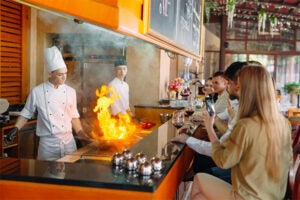
It is emphasized by Dr. Yost and her collaborator that to survive and rebuild business, restaurants must develop and maintain a relationship of trust with their customers. In this new post-pandemic age, trust is fostered through transparency around food safety and handling processes. There are three key areas where transparency would make the largest impact on a customer’s decision-making process: supply chain disruption, transparency, and information. For example, if fresh food is no longer viable, and a switch to frozen food is required to keep up with the demand, it is important to let customers know in advance. Clarity on cooking and food preparation processes is also vital, with some restaurants opting for an open kitchen to show their working practices in action. Finally, it was considered that customers should feel comfortable and safe within the restaurant, with information being supplied about policies such as social distancing, and all diners being encouraged to follow the rules. If restaurants continue to maintain trust and loyalty through acts of transparency, there is hope for businesses within the restaurant industry to recover from this unprecedented crisis.