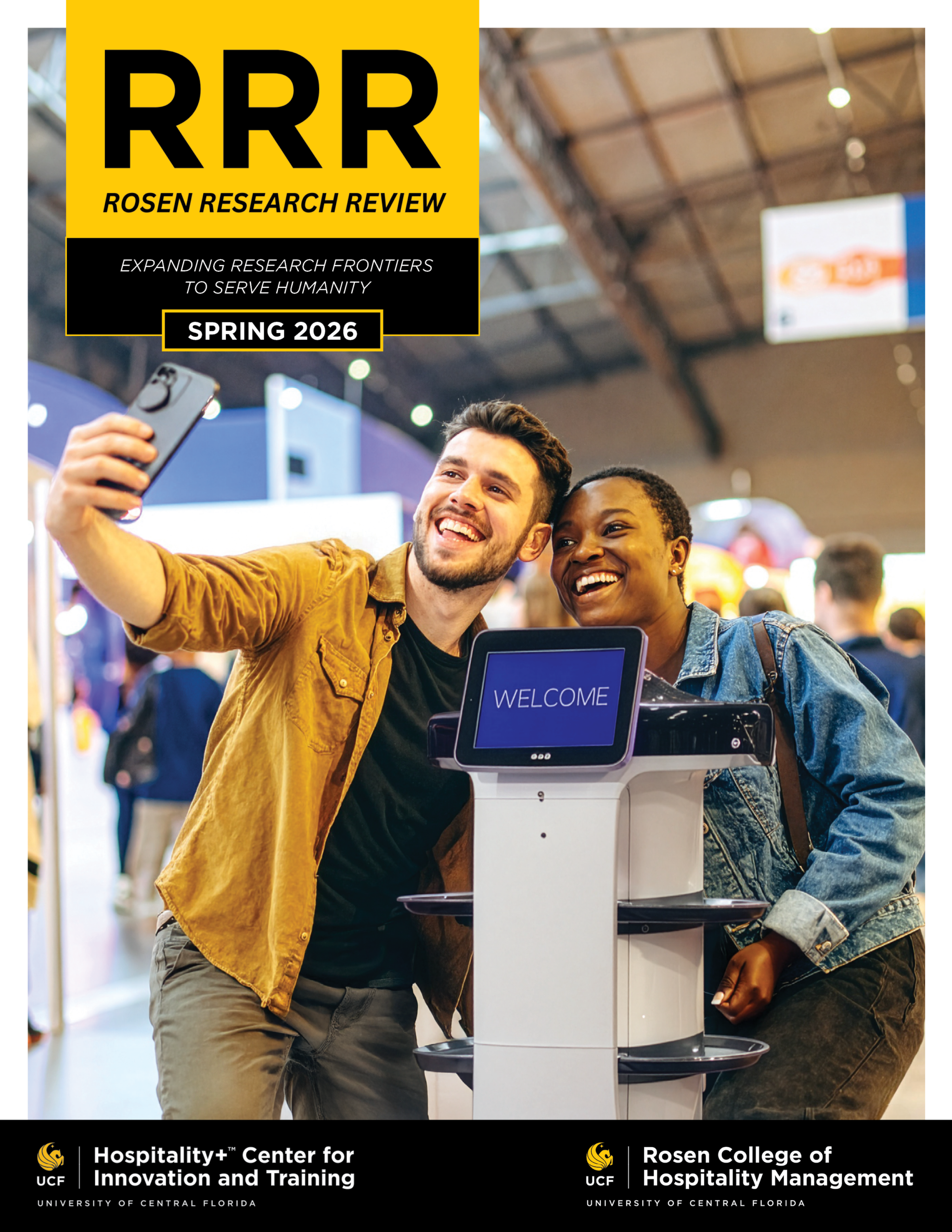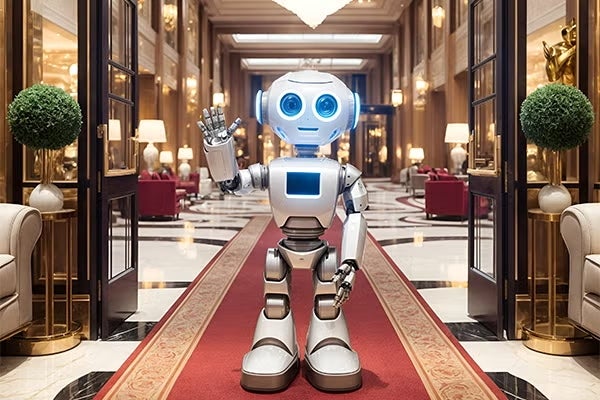
Imagine a future where you enter a hotel lobby, and instead of a smile and a warm greeting from a human concierge, a robot with a polished chrome surface and a touchscreen interface welcomes you. This scene is rapidly transitioning from science fiction to reality, and the hospitality industry stands on the brink of a robotic revolution. The allure of service robots promises a future of enhanced efficiency and novel guest experiences. However, their integration into such a profoundly personalized industry raises significant questions about guests’ perceived risks and security concerns. Pioneering this exploration into uncharted territories are UCF Rosen College of Hospitality Management’s Professor Abraham Pizam, Dr. Ahmet Ozturk and their co-authors. Their extensive study seeks to decode the complexities surrounding the deployment of robotic technologies in hotels.
Service robots have worked their way into widespread locales within the broader hospitality industry, including hotels, cruise ships, restaurants, and senior living facilities. Currently, their roles are limited, but their future looks bright. With the remarkable development, spread, and acceptance of AI over recent years, robots, in general, are likely to become more prevalent and expansive in their roles. However, what sets hospitality—the service of welcoming, receiving, hosting, or entertaining guests—apart from many other industries is its reliance on the human touch. That doesn’t necessarily mean hospitality robots will be relegated to non-guest-facing roles. The roles of service robots in hospitality will be determined by how guests feel about reaching out to them.
UNDERSTANDING THE UNKNOWNS
The hesitation to accept robots in service roles is not merely a reluctance towards new technology but a multifaceted concern deeply rooted in perceived risks. New technology comes with sparkle and promise, but its novelty harbors deep unknowns. Understanding and addressing those unknowns is critical for any new technology’s uptake. This is especially the case where robots and humans interact.
Recognizing the profound implications of integrating service robots within an industry celebrated for its personalized services, Professor Pizam, Dr. Ozturk and their co-authors set out to explore how perceived risks and information security concerns influence guests’ willingness to engage with such technology.
Their combined expertise bridges the gap between theoretical research and practical insights. Pizam, with his profound understanding of hospitality management, and Ozturk, with his analytical acumen as a specialist in IT adoption, together crafted a study that not only adds to academic literature but also offers tangible strategies for hospitality practitioners looking to navigate the new terrain of service robotics. Their inquiry centered on whether the efficiency and novelty offered by robots could harmoniously coexist with the high-touch ethos of hospitality.
The researchers constructed a methodological framework that was as thorough as it was rigorous. Their study was structured around a survey designed to probe deep into the guests’ psyche, exploring their concerns and expectations regarding hotel robotic services. They developed a series of questions that assessed guests’ comfort levels with robots and their apprehensions about the physical safety, privacy, performance reliability, and economic implications of robotic interactions.
They deployed the survey targeting individuals who had recently stayed in a hotel—sometime in the previous 12 months—ensuring that the respondents were well-acquainted with the current dynamics of hotel services. This approach helped accurately reflect current guest expectations and their readiness to accept new technologies.
To ensure a diverse and culturally rich dataset, Pizam, Ozturk and their co-authors reached out to former hotel guests across eleven countries—the United States, United Kingdom, Turkey, Spain, Romania, Japan, Israel, India, Greece, Canada, and Brazil. This international scope was crucial because cultural predispositions can significantly influence technological acceptance. What emerged was a wealth of data from which the researchers hoped to paint a comprehensive picture of how hotel guests worldwide perceive the risks of engaging with hotel robots and issues of information security.
TELLING THE STORY
Data on their own don’t tell a story—the connections between the data do. The researchers were able to rigorously analyze the data by using structural equation modeling (SEM). This powerful statistical technique combines aspects of factor analysis and multiple regression analysis to explore complex causal relationships and construct models that include both observed (measurable) variables and latent (unobservable) constructs. For Pizam and Ozturk, this wasn’t just about crunching numbers but about interpreting complex relationships within the data to extract meaningful insights.
The findings were revealing. Perceived risk emerged as a significant barrier. The study dissected this into four categories: physical, psychological, performance, and financial risks. Each played a role in shaping a guest’s reluctance or readiness to interact with a robotic service. Guests expressed significant concerns about the potential for robots to malfunction, potentially leading to physical mishaps. Moreover, there was a palpable fear that interactions with robots might lack the personal touch and warmth quintessential to the hospitality experience, highlighting psychological risks.
Conversely, the study found that robust information security practices could dramatically enhance guest trust. It demonstrated that when guests trust that their personal information is secure, their willingness to engage with robotic services increases. This is a crucial finding, emphasizing the need for hotels to invest in advanced cybersecurity measures as they integrate more digital and robotic solutions into their operations.
An intriguing aspect of the study was how it spotlighted the role of guests’ personal traits, like self-efficacy and innovativeness, in mediating the relationship between perceived risk and the acceptance of robots. Behavioral intentions are critical facilitating conditions. Guests who are confident in their ability to use new technologies and those who are naturally inclined toward innovations are more likely to embrace robotic services. This points to a broader implication: education and familiarization could play critical roles in accelerating the adoption of robotics in hospitality.
IMPLICATION AND INSIGHTS
Pizam and Ozturk’s work offers profound insights for the hospitality industry as it navigates this new technological frontier. Their findings suggest that while integrating robots in service roles presents clear advantages in terms of efficiency and novelty, it also requires careful management of guest perceptions and concerns.
Their study emphasizes the need for hotels to invest in robust cybersecurity measures and communicate transparently with guests about how their data is protected. Additionally, the hospitality sector must address guests’ psychological and performance-related apprehensions to ensure that the robotic revolution enhances rather than detracts from the guest experience.
As the hospitality industry continues to evolve, the insights provided by this study will undoubtedly play a crucial role in shaping strategies for robotic integration. The research highlights the importance of balancing technological advancements with an unwavering commitment to guest satisfaction and trust.
To this end, the study is not just an academic exercise but a beacon for the hospitality industry as it stands on the threshold of a technological revolution. The insights from their research provide a roadmap for managing the transition to a more automated service environment, where guest acceptance is as much about managing perceptions of risk as it is about ensuring robust security protocols.
As robots begin to find their place in hotel receptions and corridors, the work of Pizam, Ozturk and their co-authors will undoubtedly continue to guide the industry toward a future where technology enhances human service rather than replaces it. In this brave new world of hospitality, understanding and addressing guest hesitations and building robust trust mechanisms will be vital in making the robotic revolution not just a reality, but a welcome one at that.