If you’re expecting traditional ivy-covered walls, lecture halls designed to seat hundreds, textbooks that weigh a ton, and stodgy professors, that’s not what you’ll find on the campus of UCF Rosen College of Hospitality Management.
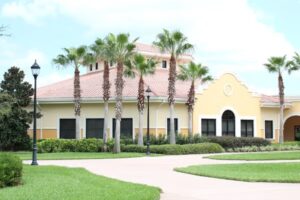
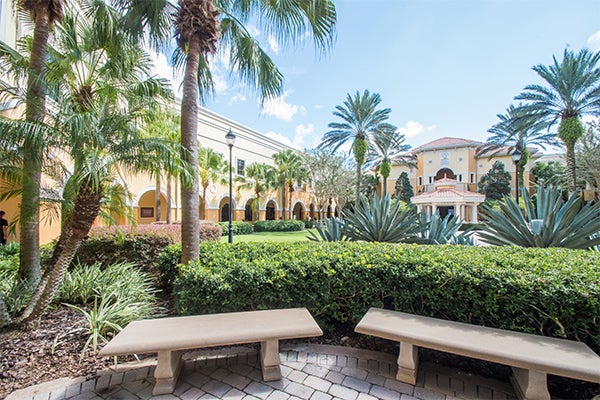
Built in the heart of hospitality: Orlando, Florida, the college—one of the 12 at the University of Central Florida—looks more like a resort than an institute for higher education. Yes, the college uses traditional teaching methods like lectures to educate the more than 3,000 undergraduate and graduate students who attend Rosen College, but there is so much more to discover here. The education offerings have evolved to meet the demands of a changing industry, the expectations of its students who were born and raised in the era of mobile devices, and the technological advances that proliferate all sectors of the professional job market. In the past 12 months, UCF Rosen College has added a plethora of technology to its roster of tools to enhance the education experience.
Among them are:
• Lightboard Recording Studio Package is a dedicated studio for producing instructional video micro-lectures. A Lightboard is a sheet of tempered ‘StarPhire’ glass, custom produced for the highest level of clarity possible, edge-lit with LEDs, and mounted on a sturdy frame. When the glass is written on using a fluorescent marker, the ink will glow and become plainly visible. A camera on the other side of the glass records the video while reversing the frames to make the text readable. As a result, from the teacher’s point of view, he or she is writing on a surface analogous to a chalkboard while facing a camera. From the student’s point of view, the teacher makes eye contact while writing in midair.
• Microsoft Teams Calling Telephony is an effective cloud-based Voice Over Internet Protocol, or VOIP, as its commonly known, and is a calling and messaging solution that enables faculty and staff to work from anywhere, from any device, desktop, laptop or mobile device.
• Theatre Lighting – Through industry partnerships with Entertainment Technology Partners (ETP) and its parent company LMG, the college has been able to add modern theatre-style lighting in the Darden Auditorium to enhance the classroom experience for the Entertainment and Event Management degree programs. This has also allowed us to offer customized stage and room lighting to our guests, thereby enhancing their event experience. With the new lighting, the classes that utilize the auditorium have enjoyed an alumni festival musician in a performance atmosphere and an entertainment management producer who was able to demonstrate some of the techniques he uses on the road.
• Zuddl App – In June of 2021, we hosted our first hybrid experience, the alumni event Hospitality Knight, on Zuddl. Zuddl is an interactive cloud-based event platform that allows for avatars to stand in for invited guests in virtual reality spaces so lifelike, they look like the real thing. We also hosted a virtual career fair in spring 2022 using Zuddl. This robust event platform enabled us to build a custom branded event that provided opportunities for more than 50 employers and hundreds of students to meet, interview, and host workshops. The Zuddl based career fair was in addition to our traditional onsite event.
• Microsoft Surface Hub is a sleek interactive live whiteboard with video conferencing capabilities. The Hub is a great mobile solution for small group video conferencing sessions, and because it integrates into the Microsoft Teams platform, it allows for file sharing internally. The Hub is basically a virtual office on wheels. It brings together whiteboarding, video conferencing and projection, and integrates seamlessly with Windows 10, Microsoft Teams, Office, OneNote and Universal Windows.
• Microsoft HoloLens – In collaboration with other UCF colleges, Rosen College acquired these devices for faculty involved in research activities related to A-I and simulations. The HoloLens is a pair of mixed reality smart glasses developed and manufactured by Microsoft. HoloLens was the first headmounted display running the Windows Mixed Reality platform under the Windows 10 computer operating system.
The college has also invested heavily in instructional technology to ensure our faculty and students continue to have the best teaching and learning experiences:
• Webcams have been installed in all lecture spaces and conference rooms to accommodate various teaching modalities and pedagogies.
• Video conferencing software such as Panopto and Zoom are also being used for remote instruction and learning, which allows for classes to be conducted at flexible times, day or night. This helps accommodate the schedules of students who work, and faculty who conduct research in their chosen fields of study in addition to teaching.
• Software upgrades with an emphasis on productivity and research software have been made both in the student computer labs and the graduate studies suite computers which are used heavily by our Ph.D. students.
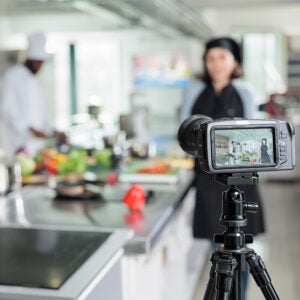
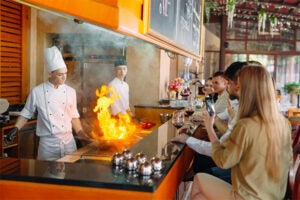
• Our new Cooking Demonstration Lab is also in heavy use. It comes equipped with custom cooking ranges, plus flexible multimedia technologies such as PTZ cameras, which allow the operator to pan, tilt and zoom the robotic video cameras to show various angles and image formats during a learning experience. New microphones, Creston system integration and wall displays have also been added to the lab. Since the installations, we’ve partnered with faculty from other colleges and professional associations for creative and innovative cooking demonstrations and courses, such as culinary medicine. The lab will also be used this summer during the Health Meets Food conference, June 9-12.
All the great tech was not relegated simply to classroom settings. We have upgraded our faculty and staff computers to high performance PCs with the most current Microsoft operating system. Software upgrades have included administrative, productivity, and research software. Many faculty and staff members also received mobile computing devices, laptops and tablets: essential tools for remote learning and administrative tasks.
While adding all this technology to the college, the Information Technology team continues its green initiative when it comes to the products used in our printers. The team continues to pursue environmental sustainability efforts using soy-based printer toner cartridges and server infrastructure virtualization. You can learn more about the university’s sustainability programs on the website.
The classroom of the future exists at UCF Rosen College. The investment made in the technology upgrades demonstrates why the college is #1 in the nation and #2 in the world when it comes to hospitality education and research.