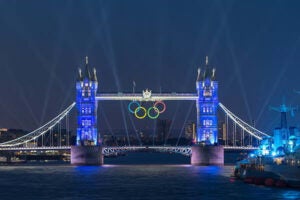
Borne out of the success of London 2012 Olympics, Trivandi was set up to share knowledge and expertise in leading the design, delivery, and operations of major events and high-profile venues. Since then, Trivandi has gone from strength to strength, delivering the world’s biggest and most-complex mega projects. Their impressive portfolio includes 200 projects in 26 countries including Super Bowl 50 in San Francisco, FIFA World Cup Qatar 2022, Pan American Games, and The Commonwealth Games.
WHO IS TRIVANDI AND WHAT DO YOU DO AS CEO?
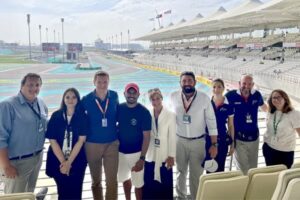
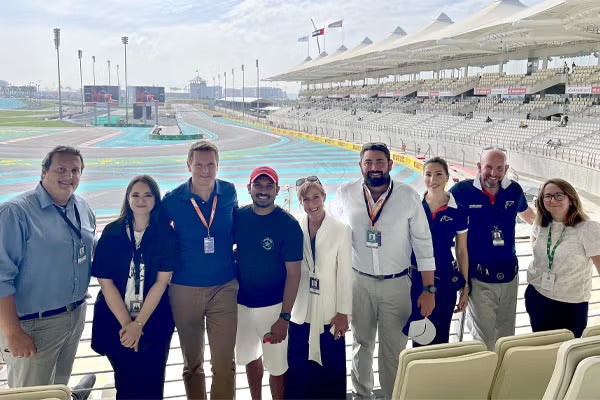
Trivandi was set up in 2013 by members of the senior leadership team of the London 2012 Olympic Organizing Committee, to share the knowledge of what it took to deliver the Games. Over the last 10 years, Trivandi has advised on and delivered more than 200 major event and venue projects across 26 countries. Trivandi has grown to 50 permanent staff with four global offices in the UK, UAE, Saudi Arabia, and Qatar, as well as an ‘Associate Network’ of over 1,400 Subject Matter Experts. We apply a unique ‘One Team’ approach where our strategic and commercial advisors, designers, project managers, venue and event managers, and sustainability specialists work side by side to drive projects to success, from concept to execution. We have worked on every summer Olympic Games since London 2012, Expos in Dubai, Doha and Osaka, Super Bowl 50 in San Francisco, FIFA World Cup Qatar 2022, F1 Grand Prix in Abu Dhabi and Saudi Arabia, Eden Project UK and International, Aston Villa FC Stadium, the Pyramids of Giza, and multisport events such as the Pan American Games, Asian Games and Commonwealth Games. My role as CEO is to drive forward our mission to continually improve the delivery and operation of events and venues, leave a sustainable legacy, and train local people to do what we do. Put simply, I see my job as devising and delivering Trivandi business strategy and inspiring our people and partners to push the boundaries in event and venue delivery, to make an impact in our industry. At the moment, I am based in Dubai, to support our fast-growing teams in the region, while also overseeing our wider global business. The Middle East has become an epicenter for giga projects where you can design and deliver major events and venues at the most innovative and creative level, with unprecedented ambition and scale.
CAN YOU TELL US A LITTLE ABOUT YOURSELF?
In my early years, I was passionate about sport and wanted to follow a career in sport. However, my parents had different ideas and preferred me to make a career in the business. I studied real estate and construction, becoming a chartered building surveyor. I started my career as a property consultant and worked for Drivers Jonas (which merged with Deloitte in 2010, becoming Deloitte Real Estate), where fortunately, I was able to combine my profession with my passion, by providing property and construction advice to the sport and leisure sectors in the UK and Europe. In 1998 I co-founded DJ Sport, a sector focused on sport and leisure business within Drivers Jonas. I was working for 40% of the clubs in the English Premier League helping them optimize their assets and delivering new stadia. However, in October 2003, I landed my dream job when I was appointed as Director of Venues and Infrastructure for London’s bid to host the 2012 Olympic and Paralympic Games. When London won the bid in 2005, I was invited to continue in the same position for the Organizing Committee, where I led a department of over 1,100 employees and oversaw 35,000 Games-time staff to plan and operate the 120 sites and venues required for the Games. A key aspect of my brief was to transform a derelict part of East London into a world-class Olympic Park capable of hosting 10,500 athletes and nine million visitors, while leaving a lasting social, economic, sports, and infrastructure legacy for years to come. After the Games finished, I had caught the bug for delivering major event and venue projects, leading me to form Trivandi with my fellow members of the London 2012 Venues and Infrastructure team, Paul May, and Jonathan Branson, and we’re still going 10 years later!
WHAT ARE THE MAJOR CHALLENGES YOU FACE AS CEO?
Mega events like Olympic Games, FIFA World Cups, and Continental level Games have a major impact on the host city/country. They are national projects which require the attention of the country’s leadership. As the CEO of Trivandi, I am usually required to brief senior ministers, and so get drawn into a lot of project work. This limits my time to focus on developing our business and delivering strategy. To manage this, we have headhunted the top people in the industry to lead our business units. Each business unit effectively runs their portfolio as a business with their own targets and profit and loss. They are their country’s leadership, on the world stage. However, the media scrutiny that comes with these high-profile events has also shone a spotlight on repeated failings in major event planning and delivery. Examples include this year’s UEFA Champions League final in Paris where Liverpool fans struggled to get into the stadium, creating dangerous crowd control challenges; the recent Burning Man festival where people were held there due to the lack of a bad weather contingency plan; the start of this year’s Rugby World Cup where thousands of ticket-holders missed the start of the England versus Argentina match in Marseille because of bottlenecks outside the stadium; the Euro 2020 finals where fans stormed London’s Wembley Stadium; or cast your mind back to the tragedy at Brixton Academy in London when two people lost their lives trying to get into a concert. Why is this repeatedly happening? I can boil it down to three key challenges and problems within the events industry: There’s no ISO standard for major event planning that guides and requires compliance of major event planners to meet certain standards and regulate the control of major event delivery. There is no industry body assessing professional competence of event planners, and there’s no professional members association for event planners to set standards in compliance. If you think about other professions such as lawyers, doctors, solicitors, accountants, engineers, and architects, all require certain standards and professional levels of competence, continuous professional development (CPD) and ethics to practice, and all have member association bodies. There is nothing similar for the events industry. There is no industry-recognized certified training qualification for major event planners. While there are degree courses and similar for event management, it’s important to understand that events like the Olympic Games, FIFA World Cup, World Expos, etc., are highly complex events to plan and operate. The majority of people planning them don’t have specific qualifications or training, there’s no assessment of professional competence, and there’s no effective industry-wide transfer of knowledge.
HOW CAN WE OVERCOME THESE CHALLENGES?
I believe there are three key things we can do to improve the events industry, and we need to do these now: Develop an international major event delivery standard. Not only should this provide guidance and recommendations to event planners, but there should be a quality assured certification process to ensure compliance with the standards through ongoing assessment of the planning and delivery of the event. Create a member association for the events industry. This should provide a professional assessment and certification of skills, experience, ethics, and professional conduct, along with lifelong CPD. This gives assurance that members have attained and maintained a certain level of competence to deliver major events. Create a major event training academic program. This could include a certified course for event professionals covering every stage of the event lifecycle. This could also enable research and innovation to review and thoroughly evaluate what was achieved at previous major events, as well as a critical transfer of knowledge that goes from people to people, not just organization to organization.
WHAT WOULD BE YOUR FIVE TOP TIPS OR ADVICE FOR STUDENTS THINKING ABOUT WORKING IN THE MAJOR EVENTS INDUSTRY?
Do your research on the events ecosystem: There are many different types of events, from weddings to conferences and major sport events. There are many different event companies and job roles, from creative agencies, production agencies, major event planners and promoters. Discover what you are most interested in, speak to people in the industry; what lights a spark inside you? Gain job experience: Seek opportunities for internships/work experience/volunteering at different events and different event companies/organisations and gain real life experience to know what it’s actually like. Work across as many different functions (show production, spectator services, hospitality, venue management, operations etc.) as you can when you start out to gain an in-depth understanding of the different roles. Ask lots of questions! Build your network: Meet as many people as possible and build your network in the industry. Get connected on professional networks like LinkedIn. Follow event companies, sponsors, and rights holders. Find the right company culture for you: An organisation where you really enjoy being around its people, where you can set ambitious goals, and where your colleagues will do whatever they can to help you achieve them. How do you find this place? Search organizations you admire. Search for their values, read their social media posts. Is it about the people, talking passionately about what they do or a corporate entity with no personality? Does it convey a team ethos, one that supports growth? When you get an interview ask this question. ‘If I wanted to do x or be y, what support will you give me to get there?’ The way this question is answered will tell you a lot about the organisation. Be prepared to work hard and roll up your sleeves: I’ve worked with high-profile CEOs who have got involved with moving barriers or furniture when needed. This is the mindset you need to succeed in this industry—it’s all about getting the job done whatever it takes, being incredibly resourceful and putting in long shifts. And having fun!
WHAT DO YOU THINK ARE KEY AREAS FOR RESEARCH WITHIN THE EVENTS INDUSTRY?
I think that AI is a key area that is going to transform the events industry, as with all industries. The world of technology is moving so quickly now with AI that we’re going to see some extraordinary new advances and changes in a very short space of time compared to the last 10 years. Trivandi has a research and innovation unit which is looking into how we can embrace AI and utilize it to improve and enhance the way we plan, operate, and consume events. This might include architectural design, project planning, crowd flow modeling, event presentation, guest experience, and overall event operations. Driving innovation will be critical to the industry to keep abreast of the speed of change that we will see in the next 10 years. It also is an opportunity to create time, budget and resource efficiencies and ensure that we are delivering highly sustainable outcomes and solutions. Another key area is sustainability. While many event owners are now embracing sustainability, there is a lot more to be done. I expect to see innovative solutions both in event infrastructure and operations coming forward. I’m Chairman of solar solutions company Solivus Ltd. and, for example, we are pioneering new applications for flexible solar that can be used in innovative ways to reduce reliance on temporary event generators. Solving problems, like re-use of materials for temporary exhibition stands and event structures, power generation, sustainable transport solutions and technology applications will see us move closer to achieving net zero events.
WHAT HAS BEEN YOUR EXPERIENCE WORKING WITH DR. MIKE DUIGNAN AND UCF ROSEN COLLEGE OF HOSPITALITY MANAGEMENT?
I continually seek to collaborate and create partnerships with the best in the industry. Dr. Mike Duignan and I connected about two years ago. Together we have had some great conversations and discussed many of the problems and opportunities I mention above alongside key areas where events education, particularly major events, must improve and develop in the future. He has also used me as a sounding board for developing his own university program content too! What we have agreed is that we need a more practical training program that balances practitioner insights and academic rigor to best prepare the next generation of major event organizers and leaders to manage events efficiently and with social responsibility in mind. Together, universities and organizations like Trivandi can play a strong role to identify, map out, and articulate the key professional skills, knowledge and characteristics required to bring us closer to a more professionalised industry and develop new innovative programs that address the key contemporary needs of industry. I encourage all those who work in the events and sports industry to reach out to university professors like Mike and world-leading centers like the Rosen College, who are doing excellent things in the events education space—particularly their new MS Event Leadership program—and who are always keen to engage in dialogue and support the industry.