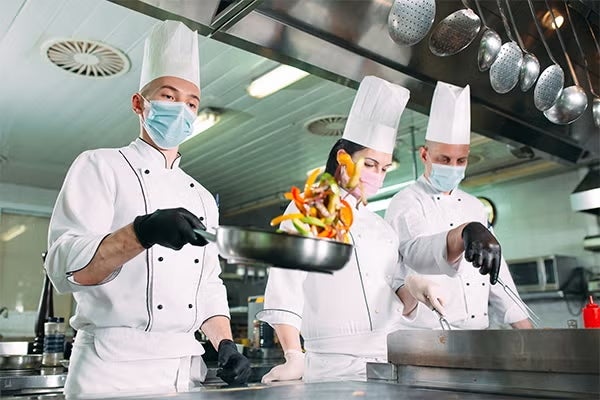
The COVID-19 pandemic has had a significant impact on the hospitality industry. Business closures and capacity controls together with travel restrictions triggered an immediate decline in the hospitality market. Most states in the U.S. lifted stay-at-home orders at the beginning of April 2020 and businesses were allowed to reopen during late April and early May 2020. This resulted in an increase in COVID-19 cases during May and June 2020. One quarter of COVID-19 cases were associated with visits to restaurants and bars. The high-contact nature of food and beverage businesses intensified people’s fears of catching the COVID-19 disease. Restaurants had to redesign their operations to provide heightened safety and security standards for their clientele with flexible mechanisms, including screens between tables, contactless menus, routine sanitization practices, and mobile payment systems, to encourage people to dine out.
Even with the upsurge in research into the adaptive approaches taken by restaurants in these shifting environments, there is still a ‘general halo of uncertainty’ surrounding the question of how to enhance quality of service and customer satisfaction but still reduce COVID-19 transmission. Bridging this knowledge gap, Associate Professor Arthur Huang from UCF Rosen College of Hospitality Management and his co-authors investigated the link between restaurants’ safety violations and COVID-19 cases. The researchers took an interdisciplinary approach employing methods and models from statistics, computer science, and geography to find out if there is a correlation between complaints made by diners regarding restaurant safety violations and the occurrence of COVID-19 cases.
PSYCHOLOGICAL MECHANISMS
The researchers adopted several theories to uncover the rationale supporting diners’ behavior during the pandemic and discover whether the complaints they raised are justified reactions to their perceived threats.
To demonstrate how psychological processes enable people to know that infectious pathogens may be present in the dining environment and prompt their behaviors to prevent any contact with sources of infection, they turn to the stimulus-organism-response (S-O-R) paradigm and the theory of behavioral immune system. The S-O-R model describes how environmental features can act as stimuli (S) influencing individuals’ emotional states (O) and subsequently trigger a behavioral response (R). The risk of infection can also activate diners’ behavioral immune system and alter their reaction to such stimuli, possibly increasing aversive reactions.
When people are exposed to pathogenic diseases, the behavioral immune system activates behavioral and cognitive responses. This encourages people to assess their environment and notice pathogen cues. Cues, such as seeing or hearing an employee cough or violate safety protocols, may cause diners to experience disgust, develop aversive responses, and judge the restaurant negatively. This may lead to them withdrawing their patronage or raising complaints.
The health belief model and the protection motivation theory explain the significant part played by diners’ perceptions and motives during this process. The health belief model explains diners’ strategies for preventing infection. It predicts whether a particular health behavior is more or less likely depending on a person’s perceptions of the severity of a disease and their susceptibility to it. During the pandemic, diners perceiving themselves to be highly susceptible to COVID-19 may choose to visit restaurants that follow safety protocols with social distancing and good sanitation. They may pay close attention to these details and if the restaurant doesn’t follow the procedures, the diners might complain or display a lack of patronage as a cautionary way of preventing contracting the disease.
The protection motivation theory is similar to the health belief model, but it also includes the influence of self-efficacy on preventive health behaviors. If diners with high self-efficacy perceive any violations of safety protocols and think that they can demonstrate an effective reaction, they may well complain.
COMPLAINTS: A PROXY INDICATOR
These theories suggest that customers’ complaints are not exaggerated responses to threatening conditions. Due to pandemic constraints, the researchers were unable to observe safety violations in person and health authority inspections occurred biannually, so identifications of violations were limited. Building on these concepts, the research team used customers’ complaints as a proxy indicator to better understand the relationship between restaurants’ safety violations and COVID-19 cases.
An extensive review of the literature showed that diners’ perceived risk of catching COVID-19 was the main reason discouraging them from visiting restaurants during the pandemic, although safety violations in the restaurant industry were an ongoing problem before the pandemic. A positive correlation between the number of customers’ complaints and the rates of foodborne outbreaks in the U.S. was revealed. Indoor dining was also connected with COVID-19 cases.
The researchers hypothesized that diners’ complaints about safety violations during the pandemic are positively correlated with H1: COVID-19 cases, H2: COVID-19 positivity rates, and H3: COVID-19 hospitalizations. In addition to testing these hypotheses, the researchers performed spatial analysis to confirm that diners’ complaints were correlated with COVID-19 cases.
The research team obtained data from a government-operated database, the Florida Department of Business and Professional Regulation (DBPR) complaint portal. This dataset comprises 2,297 location-based complaints made by restaurant guests during May and June 2020, as businesses reopened in Florida. Data variables included the date of complaint, restaurant address, and allegation notes. The dataset was linked to Florida’s daily COVID-19 cases during the same period. Initially, the data trend suggested that the number of daily complaints and COVID-19 cases were highly related.
UNDERSTANDING THE CORRELATION
The researchers carried out a statistical analysis to investigate the correlation between restaurants’ safety violations and COVID-19 transmission. To identify and analyze themes that were present within data, a thematic analysis was performed. The researchers devised a coding theme using a sample of 200 complaints. Given the large number of complaints, they developed a neural network-based natural language processing model to label the rest of the complaints. This model was pre-trained on more than 10 million restaurant reviews from Yelp.com, before fine-tuning it with the complaint data. The resulting deep learning model could classify customers’ complaints and recognize the nature of the safety violations.
More than 80% of complaints related to violations of personal protection and environmental safety measures. These increased dramatically after early June 2020. Conversely, complaints relating to food safety and quality remained stable, accounting for less than 10% of the total complaints. These were not necessarily related to COVID-19 transmission. Fine-dining restaurants received most (75%) complaints. Casual dining restaurants accounted for 19% and fast-food restaurants received only 6% of the total complaints, probably due to drive-through, take-out, and delivery options. Most complaints were about the lack of masks (both staff and customers) and social distancing.
Dr. Huang and co-authors then devised a mixed-effect linear regression model (an extension of simple linear models allowing for both fixed and random effects that account for the unmeasured sources of variance). They found statistically significant, positive correlations between the number of daily complaints and all COVID-19 transmission measures. This supports all three hypotheses. Further analysis found that complaints about personal protection measures, such as not wearing masks, had the highest correlation with COVID-19 cases. This was followed by environmental safety measures and personal sanitation measures. Although these do not automatically indicate causal relationships, these findings align with the findings of previous research.
UNCOVERING GEOGRAPHIC HOTSPOTS
COVID-19 rates may well differ across county, city, and state levels due to regional variations in both policies and human behavior. In addition to geographical variations in consumers’ restaurant patronage, densely populated areas can attract many tourists, impacting on the number of restaurants, visits, and safety violations. The researchers therefore performed spatial modeling of the geographic distribution of complaints to identify hotspots and throw light on the correlation between customers’ complaints concerning safety violations and COVID-19 cases.
Using the ArcGIS tool, Dr. Huang and co-authors calculated the Getis Ord Gi* statistics to identify geographic hotspots. This exposed an uneven distribution of customers’ complaints and COVID-19 cases but supported the positive relationship between restaurants’ violations and COVID-19 cases at the county level. As suggested in the literature, they found a significantly higher number of complaints regarding violations and COVID-19 cases at major tourist destinations, such as Miami and Orlando, than other counties. Broward County and Miami-Dade County had the most complaints about safety violations with 121 and 112 complaints, respectively.
THEORETICAL AND METHODOLOGICAL IMPLICATIONS
Huang and his co-authors describe how this research enriches the three key environmental psychology theories explaining consumers’ behavior during the outbreak of disease. The stimulus-organism-response (S-O-R) theory is enhanced with the identification of novel atmospheric subfactors in restaurants that can influence consumers’ emotions and lead to avoidance responses. The findings suggest that consumers’ behavioral immune systems may have been affected by the COVID-19 pandemic. Their research findings enhance both the health belief model and the protection motivation theory. Along with people’s internal factors, perceived environmental risks may affect consumers’ perceived threat, and this might influence the likelihood of their engagement in health-protective behaviors.
These analytical methods and their findings reveal consumers’ behavioral shifts and demonstrate how hospitality businesses adapt their practices in a pandemic. They also highlight how new management practices together with economic policies can support the safe and successful reopening and operation of restaurants.