Hospitality is a term which encompasses notions of warmth, friendliness, and comfort extended to others, across many different contexts and settings. Although the study of hospitality has traditionally been associated with a limited number of industries, attention has turned in recent years to the role of hospitality within other industries, including health care settings. It has been proposed that extending practices of hospitality to the health care environment could potentially influence health outcomes for patients receiving medical care. This extension of the notion of hospitality into other settings introduces a new concept of hospitality as an organizational culture or philosophy, with an emphasis placed upon providing exceptional service levels that satisfy all stakeholders.
HOSPITALITY IN HEALTH CARE
Dr. Wei and Dr. Zhong, of Rosen College, note that the notion of hospitality is newly relevant for recipients and providers of health care services within the context of the COVID-19 pandemic. The pandemic has disrupted the ordinary provision of health care services and required a change in the processes through which people would usually access and receive health care. It has also heightened the anxiety within health care systems for both providers and users. This has meant the concept of hospitality—with its focus upon offering comfort to others—has particular significance for participants within the health care industry.
TELEMEDICINE
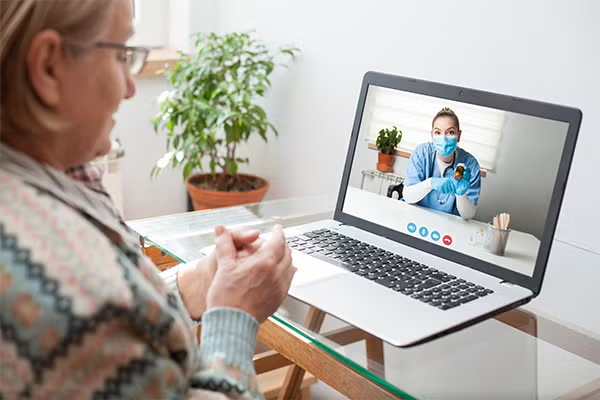
One of the key social developments related to minimizing risk through the pandemic has been the rapid transition to a digital world of work, education, entertainment, and personal service provision. Specifically, within the health care industry, the push towards digital telemedicine was accelerated by fears of contracting and transmitting the COVID-19 virus in health care settings. This resulted in the rapid adoption of telemedicine as a first line of health care provision, particularly in situations where it was appropriate to conduct consultations using digital video platforms.
Dr. Wei and Dr. Zhong point out that although telemedicine had been practiced prior to the pandemic—in circumstances where patients could not physically access a health care clinic—the pandemic significantly extended the role of telemedicine as an alternative service. It aimed to reduce the exposure of vulnerable people requiring health care services. While there has been extensive research conducted on telemedicine, Dr. Wei and Dr. Zhong point out that there are two identifiable gaps within existing research.
Firstly, much of the extant research has focused on the technological aspects of telemedicine, such as technology adoption, rather than on how hospitable the doctor is within the telemedicine service. Secondly, the telemedicine research has focused on assessing clinical outcomes and customer satisfaction, rather than assessing emotional outcomes relating to the patient–doctor interaction. Given the broader context of emotional distress brought about by the pandemic, the importance of emotional outcomes in telemedicine consultations is an important area for research. Dr. Wei and Dr. Zhong therefore researched people’s affective outcomes as a reflection of hospitable interactions, while also focusing on the role of hospitable services in telemedicine health care settings.
EMPOWERMENT THEORY
One of the key impacts of the pandemic according to Dr. Wei and Dr. Zhong is that it has deprived people of a sense of control, while leaving people feeling less empowered than they ordinarily would. This has notably been the case given quarantine and social isolation requirements through the pandemic, which have also made it difficult for people requiring medical consultations to access these services in person. In undertaking their research on the role of hospitality in telemedicine, the research team thus decided to incorporate empowerment theory. This theory was chosen to better understand how telemedicine as a process empowers users to overcome some of the emotional challenges imposed by the pandemic.
In this regard, the researchers defined two objectives for their research: firstly, to investigate how the patient’s experience with telemedicine (both the technology and the clinician) impacted their sense of perceived competency and control (i.e., empowerment); and secondly, to study the influence of empowerment on the emotional outcomes of patients, in relation to factors such as anxiety and isolation reduction.
MODELLING HOSPITALITY IN TELEMEDICINE
Dr. Wei and Dr. Zhong built a model for their research drawing on four predictive factors of empowerment derived from the technology acceptance model (TAM), a theory which has been widely adopted to assess how users come to accept new technologies. These four factors were hypothesized to be important in influencing the empowerment of patients utilizing telemedicine. These factors included: perceived usefulness of telemedicine; perceived ease of use; convenience in relation to time and place when using the technology; and technical adequacy, referring to the audio clarity and the image resolution within the telemedicine system.
It was hypothesized that these factors would impact patients’ perceived competence and perceived control. It was further hypothesized that the reliability, responsiveness, assurance, and empathy shown by the doctor during the telemedicine consultation would impact positively on the patients’ perceived competence and perceived control. Extending the hypotheses evaluated in the study further, the researchers tested whether the perceived competence and perceived control gained by a patient during the telemedicine consultation impacted positively on both isolation reduction and anxiety reduction.
METHODOLOGY
For the research study, evaluations were made of patient–clinician interactions within video-audio-based telemedicine using quantitative research methodologies, including an online questionnaire. Research participants were recruited through Amazon Mechanical Turk. Research examining data quality obtained through this platform has previously shown the data quality to be as reliable as that of other online platforms. The research was conducted over a three-day period targeting participants who had made use of video-audio telemedicine consultations in the preceding three months. A total of 499 responses were collected and out of these, 409 responses were considered usable for the purposes of the study. About half of the research participants held a four-year bachelor’s degree and about half were in the 26-to-40-year age range. Slightly more than half of the respondents were male and 62% were Caucasian.
To test the impact of the human–technology and human–human interaction in relation to the empowerment of users of telemedicine, the researchers analyzed the data using a variety of ‘regression analyses’ statistical techniques. These helped to refine the models the researchers used, and to ensure the factors they assessed were able to actively explain variations in perceived competency and perceived control.
The model utilized to assess the impact of the human–technology interactions, using the four factors—perceived technology usefulness, ease of use, convenience, and adequacy—was statistically significant, even though all the hypotheses relating to this model were not supported. Through the analyses, the model was refined and the factor relating to ‘technical adequacy’ was excluded. This three-factor model predicted 55% of perceived control, with perceived usefulness carrying the strongest weight, followed by convenience and ease of use.
The model to assess the impact of human–human interaction on empowerment was also analyzed using multiple regression analysis statistical techniques. This model was adjusted to exclude ‘assurance’ as a factor. The results indicated that the model was statistically significant, and the factors used successfully explained about 43% of the variance, with ‘reliability’ the strongest factor followed by ’empathy’ and ‘responsiveness’.
TELEMEDICINE OUTCOMES
The results of the study show that perceived competence and perceived control are significant predictors of both isolation reduction and anxiety reduction. The results further suggest that telemedicine technology empowers patients by providing them with a sense of control and competence in managing their health, through the difficulties of the pandemic. An analysis of the results also suggests that patients are pragmatic in their approach to this technology, with most respondents rating perceived usefulness, convenience, and technical adequacy as making the greatest difference to their sense of competence and control.
These research findings are highly valuable in providing objective scientific evidence to guide service providers and users of telemedicine in countering the stress involved in accessing health care through a pandemic. The results also affirm the importance of hospitality factors in the emotional outcomes of users of telemedicine, in relation to the patients’ perceived competence and control. Patients’ emotional outcomes and sense of empowerment were impacted by the doctor’s understanding of the patient’s needs, communication of reliable diagnostic information, empathy for the patient’s concerns and feelings, and ability to respond in a timely manner.