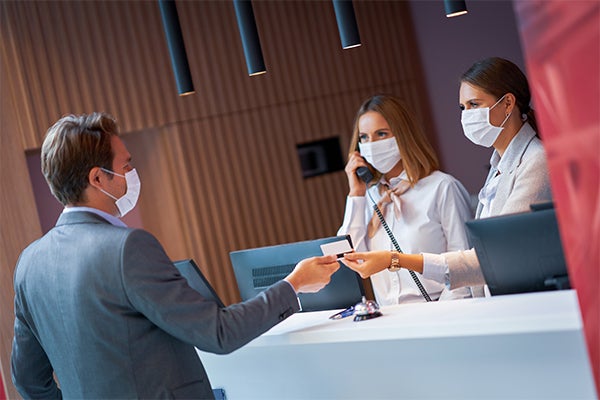
Americans are probably most familiar with the concept of heroes in capes and costumes on the big screen. The budgets these blockbusters command, and the revenues they produce would suggest we place high value on their exploits. The COVID-19 pandemic has thrown a light on a lesser-appreciated team of heroes, whose uniforms are more utilitarian and whose work circumstances are far less glamourous. However, the genuine threat posed by the global coronavirus pandemic demanded they step up, albeit reluctantly, to shield and serve others. Their newfound heroism demanded that they, and those they served, significantly reappraise their roles. How they did this is the focus of an important collaboration between UCF Rosen College’s Dr. Cynthia Mejia and a research team with UCF’s Targeted Research Training Program (TRT) based at the UCF College of Sciences Department of Psychology. As the COVID-19 pandemic shut down all but essential services, those involved in these services were thrust not only into the spotlight, but up close to the pandemic’s front lines, disproportionately exposing them to the dangers of the virus. The media and the U.S. Government were quick to champion healthcare workers and the nobility of their profession. However, the provision of food and other essential services soon made Americans realize the importance of the long supply chains and the largely vulnerable workers necessary to bring those services to their door. Workers within such services as hospitality, retail grocery, food service, consumer retail, and taxi and transportation services found themselves suddenly considered ‘heroes’—a far cry from their usually stigmatized occupations, often tainted as ‘dirty work.’ Dr. Mejia and the TRT research team were interested in how this group dealt with their new ‘hero’ status and how those outside the group balanced this with previous perceptions of work in the services industries.
Dr. Meija and her team turned to the driving force of this perceived status shift: the news media. Newspapers and TV in the United States were vital in shaping the hero narrative, so the researchers employed a critical discourse analysis methodology to scan and code the language used to describe essential workers. They examined the language used within a range of 46 news sources, including transcripts from nationally televised news sources such as CNN, MSNBC, ABC and Fox News; university newspapers; and mainstream news outlets, for the period March 30 to May 31, 2020—the early wake of the pandemic in the U.S. Their focus was how the workers, considered the ‘In-Group’, and society in general, the ‘Out-Group’, used language to frame the character and role of essential workers.
TELLING TURNS OF PHRASE
In psychology, the concept of In-Groups and Out-Groups lies within social identity theory—the belief that individuals categorize themselves into groups, identify themselves with perceived positive traits within each group, and continually compare their group to Out-Groups. Importantly, when external forces such as societal stigma, threaten the identity of a group, In-Group members are motivated to protect their group’s positive identity. Throw in a dramatic turn of events that amplifies that threat, such as a pandemic, and you have a unique research opportunity.
Using the Nexis Uni database, Dr. Mejia and her team scanned the news sources using keywords such as ‘essential worker’, ‘essential employee’, ‘critical infrastructure worker’, ‘critical infrastructure employee’, ‘hero’, ‘identity’, and ‘stigma’. The search excluded healthcare workers to focus on reports and news about line-level essential workers in hospitality, retail grocery, food service, transportation, and consumer retail—essential, customer-facing, low-paid and low-level workers, who didn’t enjoy a similar societal status as workers in healthcare. The text level data were then coded based on current literature on stigma and coping mechanisms of service workers who conduct ‘dirty’ work. A cluster mapping analysis helped organize the data according to frequency, revealing relationships between the In- and Out-Groups. In this study, the In-Group was taken to represent the essential service workers, excluding health workers, and the Out-Group was reflective of the wider public, or what can be thought of as ‘societal “outsiders”’. Finally, they identified and assembled overarching themes to help explain this rare phenomenon, especially the perceived dramatic shift in Out-Group perceptions of line-level service employees and their work.
The language in the news sources helped identify two overarching themes: ‘dangerous work’ and ‘coping mechanism’; the latter separated further into ‘In-Group or Out-Group’ coping and a more unified ‘Call to Action’ coping.
Telling in the research was that there was little improvement in the perceived conditions of the workers—the perceived stigma, and the breadth, depth and proportion of its ‘dirtiness’; if anything, especially for the In-Group, conditions were worse in the face of coronavirus. An example in the research was a line-level restaurant worker invoking images of a battlefield: ‘I am practically bathing in hand sanitizer. I fear that I’m a soldier on the front line, bound to be the first to fall. Over cheeseburgers’. The Out-Group largely echoed the sentiment around conditions, commenting on the surging death toll among line-level workers with limited access to personal protective equipment (PPE), and coping by encouraging fundraising initiatives to help secure PPE.
A clear narrative emerged from the In-Group, continually exposed to the public while doing their jobs, of the risk of contracting the virus and infecting their own families. What value did the hero status hold if it carried with it a real threat to the health of loved ones?
The ‘essentialness’ of the new ‘heroes’’ work was a common thread for both In- and Out-Groups. Truck drivers would emphasize that without them, ‘None of you would get anything,’ and those safely tucked away in lockdown would acknowledge that, ‘Everyone, whether it is the farmworkers who are picking the food, or whether it’s an MTA bus driver [is essential].’
DEALING WITH IT
So how did essential workers grapple with their sudden thrust to the frontline? In examining In-Group discourse in the source documents, Dr. Mejia and her team identified several coping mechanisms. Firstly, looking inwards, there was stronger favoritism within the group—a stronger ‘bond’, if you will. They also actively countered the popular perceptions of their work, emphasizing their role as a lifeline to society’s continuity, and reframed their work: what was previously purely a means to a paycheck was now ‘inspiring’, and their jobs were a source of camaraderie. The In-Group also employed outward defensive tactics as a coping mechanism, blaming customers without masks and pointing to the poor pay they received for such dangerous, essential work.
For the Out-Group, coping with their perceptions of essential workers’ hero status came largely through confronting or countering previous perceptions and then broadcasting their support—for example, farmers who made plans to get products directly to consumers were championed as ‘innovative’. The new situation also encouraged the re-examination of the ethics of remuneration and the reframing of low-paid essential workers dealing with ‘dirty’ work in the face of COVID, compared with those in society who transitioned seamlessly to stay-at-home work. The Out-Group weren’t averse to blame, either. Their focus was invariably on those who didn’t wear masks; employers for not protecting their staff; the U.S. Government for its perceived myriad failures in testing, tracing, and PPE rollout; and a broad range of ‘others’ for not rising to the occasion to protect the health and safety of essential service workers. Finally, the Out-Group expressed their readiness to reframe the perceptions of the occupations of essential service workers, although anecdotally, the intensity around these good intentions has waned. Dr. Mejia presents a rare opportunity for these workers as a case in point: an argument for better pay before the U.S. House of Representatives on May 25, 2020: ‘The question is, should we rectify a situation where people are actually worse off financially for showing up in an essential job, and should we recognize their willingness to put themselves at risk, which these individuals did, for two-plus solid months with a very modest [paycheck]?’
AN OPPORTUNITY FOR CHANGE
It’s tempting to look at the COVID-19 pandemic and its impacts in a purely negative light, but if there’s one thing clear in the work of Dr. Mejia and her colleagues at UCF’s Targeted Research Training Program, it’s that the pandemic created a rare event. Their research shows that during the pandemic’s early days, there was a period of alignment of opinion in the discourse of line-level workers and those who usually dismiss their occupations as unskilled and non-essential. Both group members recognized the value and shortfalls in current protections for essential, stigmatized workers.
This is an opportunity for a dramatic change in the conditions for line-level workers within the hospitality and related services industries. It is an appropriate time to address some of the inequities they face—low pay, lack of health insurance and an absence of ancillary services, such as daycare.
Because not all heroes can always help, sometimes they need help themselves.