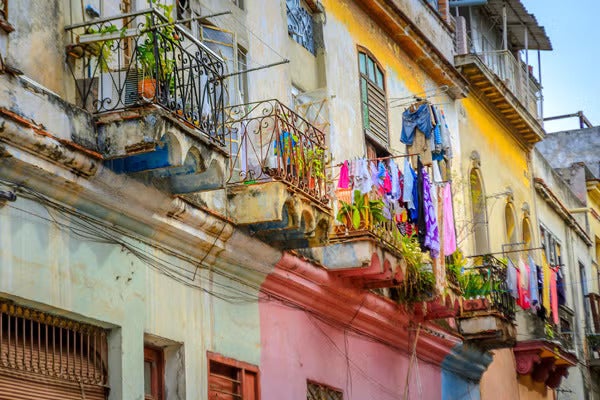
While country and destination image have long been key ideas in tourism marketing, they are often treated as separate concepts. Chaulagain, Wiitala and Fu’s research instead combines the two concepts and applies them to the specific case of tourism to Cuba. The results offer a reliable and detailed insight into how travel marketing can make Cuba more appealing to American tourists. The researchers hope that if their advice is followed, travelers will have a stronger intention to travel to Cuba and the country’s tourism industry and economy will receive a much-needed boost.
THE DIFFERENCE BETWEEN COUNTRY IMAGE AND DESTINATION IMAGE
The researchers’ work is based on two key concepts: country image and destination image. These are similar, related ideas but they have individual definitions. Destination image is the perception that someone has of a specific tourist destination, while country image is the perception that a person has of the country that destination is in. Destination image is most succinctly and accurately defined by Crompton as “the sum of beliefs, ideas and impressions that a person has of a destination.” Country image can be defined as “the sum of beliefs, ideas and impressions that a person has of a country.” Both concepts are linked to a person’s perceptions and have been used in marketing and consumer behavior research.
HOW CAN TOURISM BE IMPACTED?
Previous studies have suggested a clear and consistent link between country image and intent to visit and destination image and intent to visit. It follows, therefore, that both country image and destination image positively impact on the tourism industry by increasing the likelihood that an individual will travel to that country or destination. However, they have mostly been discussed separately, with few studies examining the link between the two concepts. In particular, there is little research discussing whether country image and destination image can impact one another.
The team from Rosen College were keen to discover whether there was a connection between them, as well as measuring their impact on intent to visit. In order to examine these ideas more precisely, the group examined the concepts of country image and destination image within the context of tourism to Cuba.
A LOOK AT CUBA
When it comes to American tourists, Cuba is a particularly interesting country to study. Country image changes over time, partly due to a changing political climate. Relations between Cuba and America have been turbulent over the last few decades, but vast improvements have been made more recently.
In 1959, Fidel Castro overthrew the United States-backed government of Cuba. He established a socialist and anti-capitalist society, which was allied to one of America’s greatest enemies, the Soviet Union. The fundamental difference between the capitalist and democratic United States and the socialist and authoritarian Cuba meant that Americans had a generally negative image of Cuba as a country at this time.
Before 1959, U.S. tourists accounted for 85% of all visitors in Cuba. After the rise of Castro, however, this number reduced rapidly and significantly with the country being relatively closed to foreign visitors. It was not until the year 2000 that Cuba began to open up its tourism industry, around a decade after its Soviet allies had collapsed. This led to a doubling in the number of tourists visiting Cuba, but Americans were still generally unwilling to visit the country. In 2016, U.S. tourists made up just 281,706 of a total four million holiday visitors to Cuba. Clearly, there is still something holding back American visitors from visiting Cuba. Although tensions have reduced, decades of rivalry are likely to have impacted the image that Americans have of Cuba. Added to this is the hostile approach that President Donald Trump has taken, reinstating the restrictions on travel to Cuba that had been previously lifted. This is therefore an interesting case study for Chaulagain, Wiitala and Fu, who wish to discover how far country image is impacting on the intent of travelers to visit Cuban tourist destinations like Havana, Vinales, and Varadero.
METHODOLOGY AND DATA ANALYSIS
They used a questionnaire to gauge the country image and destination image that American citizens have of Cuba. Each question is answered using a seven-point scale, where 1 = strongly disagree and 7 = strongly agree.
The only requirements of participants were that they were U.S. citizens aged over 18. Their data was collected using a crowdsourcing platform (i.e., Amazon’s Mechanical Turk). In total, data was gathered from 410 people of which 353 responses were considered valid. It is important to note that 60% of participants were male, 70% were white, and 60.3% were aged between 26 and 35. The sample size is considered adequate for this kind of analysis and the results are valid and worthy of discussion.
WHAT WERE THE FINDINGS?
As mentioned, there is an empirically verified link between country image and intent to visit, as well as destination image and intent to visit. For this study, the researchers wanted to discover which factors most significantly contribute to a person’s perception of Cuba as a tourist destination.
Chaulagain, Wiitala and Fu found that the biggest contributor to destination image is the quality of hospitality and entertainment services. After this, the state of local attractions and perceived value had the most significant impact on destination image. The researchers highlight these three areas as having the greatest impact on a person’s Cuban destination image and subsequently their intent to visit that destination.
With regards to country image, the biggest contributing factors were slightly different. Results suggest that the perceived level of safety and security has the greatest effect on a person’s image of Cuba as a country. After this, people’s perceptions of Cuba are impacted the most by the environmental, technological, and political environment. Chaulagain, Wiitala and Fu also found that country image and destination image positively influence intent to visit and that country image impacts upon destination image. When comparing the relative importance of country image and destination image on the intent to travel, the results were similar, indicating that country image and destination image in regard to Cuba are equally important. In addition, the study results suggest that if a person has a positive perception of Cuba as a country, then they also have a positive perception of holiday destinations within Cuba. Conversely, the more negative a view of Cuba held by a person, the more negative the same person’s view of Cuban destinations. So, in order to boost tourism to specific destinations within Cuba, marketers need to focus on improving the image of Cuba as a whole.
The final finding is destination familiarity significantly moderated the relationships between country image and destination image, and destination image and intention to visit. The results indicated that the positive impact of country image on destination image was stronger for the high familiarity group than the low familiarity group, and the positive impact of destination image on intent to visit was stronger for the high familiarity group than the low familiarity group.
WHAT ARE THE IMPLICATIONS FOR THE TOURISM MARKETING INDUSTRY?
This research has been carried out by the group as a way of measuring the link between country and destination image and intent to travel to Cuba, a country which depends upon its tourism industry for economic growth. Cuba is failing to attract US tourists after decades of hostilities. This research suggests that a boost in country and destination image could help to increase visitation from Americans.
In particular, the country of Cuba needs to focus on promoting itself as a safe, environmentally conscious, technologically advanced, and politically stable society. Meanwhile, tourist destinations within Cuba should market their hospitality, entertainment services, and local attractions. This will increase the perceived value of Cuban destinations among Americans, thereby increasing their intent to visit.
Chaulagain, Wiitala and Fu’s research builds on many decades’ worth of studies within tourism marketing and related fields. Unlike previous research, however, it looks at the causal link between country image and destination image. It also applies the concepts to a specific example of Cuba. Due to a turbulent and hostile history, US perceptions of Cuba as a country are low. Improving the country image that people have of Cuba will increase visitation to tourism destinations that Cuba’s economy desperately requires.