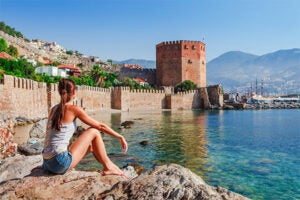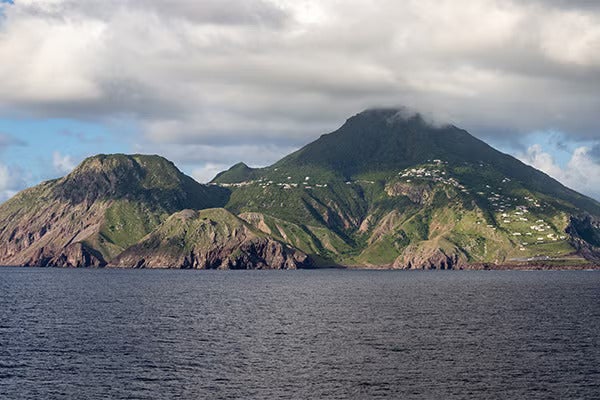
Tourists who are looking for an island that is environmentally unspoiled and want to unplug from technology, relax, and immerse themselves in the tranquillity of nature—both above water and below—should explore the Dutch island of Saba. A small volcanic island located in the Caribbean Sea; Saba is approximately 5 square miles in size. Saba is the smallest Netherlands municipality and is part of the Lesser Antilles Volcanic Arc chain of islands. The neighboring islands include Sint Eustatius, Sint Maarten, and Sain Barthelemy. Tourists can arrive by ferry (sea) or airplane. The airlift capacity is limited. When arriving by air, tourists will land on the shortest runway in the world and immediately find themselves immersed in the local culture given that there is no mass tourism on Saba, so there are barely any tourists on the island. The island is primarily known for its beautiful scenery and weather, unique architecture, pristine scuba diving, ecotourism activities, a cloud rainforest, and being ‘small’ in size and population. The sea surrounding Saba is rough. The island is home to about 2,000 people who have ancestry from the Netherlands, England, Scotland, Ireland, and Africa. Most Saban families have lived on the island for generations. Bruce Zagers is Commissioner of Tourism at Saba. Dr. Kelly Semrad interviews him about his role as commissioner, the challenges of climate change, and his collaboration with UCF’s Rosen College of Hospitality Management in the development of a new tourism master plan.
WHAT DOES A COMMISSIONER OF TOURISM FOR THE PUBLIC ENTITY OF SABA DO?
The role of Commissioner of Tourism is not necessarily clearly defined. Being responsible for the tourism portfolio means that I am politically responsible for what happens in tourism on the island. Over the years, the role has been more reserved, whereas I support the initiatives that come from our tourist office as they are the experts. More generally, I lobby for money both locally and nationally, to support the tourism initiatives. I am also very active with the connectivity groups, as this remains one of the bigger challenges for us as a tourist destination. If there needs to be stakeholder consultations, or if there are questions coming from the Island Council about tourism-related matters, I am responsible for addressing these groups accordingly. I also lobby and spearhead programs when assistance is needed for the hospitality sector, such as with the stimulus fund that was created to help businesses during the pandemic.
HOW DOES ONE BECOME A COMMISSIONER OF TOURISM IN SABA?
After each election, two Commissioners are appointed by the Island Council. Those two Commissioners, along with the Island Governor, then form the Executive Council. Once this process has been completed, the Executive Council will meet to determine how the portfolios are to be divided between them. For the past few terms, I have had more of the economic and infrastructure-type portfolios, which include tourism, whereas my colleague Commissioner has more of a focus in the social domain and healthcare fields.
WHAT ARE THE MAJOR CHALLENGES THAT YOU FACE IN YOUR CURRENT PROFESSIONAL POSITION?
Being a Commissioner on such a small island isn’t always an easy job. On a personal level, I am the Commissioner at the office, at the grocery store, at the restaurants, and everywhere imaginable! Knowing everyone on the island and having to, at times, make complex decisions about people you know can be difficult, especially when you know that you will see these same people regularly. There is no such thing as having a private life where you are not seen as a political leader as your every move is watched and analyzed. This does become overwhelming at times.
Although Saba is a special municipality of the Netherlands, we face many of the same challenges as other islands in the Caribbean region such as poverty, high cost of living, limited connectivity, etc. Over the years we have seen vast improvements because of our relationship with the Netherlands, however, the pace of these improvements is sometimes slow even though we share the same ambitions.
Because we are such a small island, we are also faced with the challenge of being very dependent on the outside world. Almost everything that is needed on the island must be imported. We do have regular shipping lines and for the most part we are all able to offer most products and amenities that can be found on bigger islands and countries, which is a pleasant surprise to our visitors. However, when something happens, for example to St. Maarten or in the Miami area, this impacts our ability to get the supplies that we need. This is why we are beginning to focus on becoming more self-sustainable. In the coming years, our goal is to reduce our dependence on diesel-generated energy and become 90% reliable on solar and wind energy. We are also increasing our focus on producing more of our own food locally through initiatives that will make traditional farming more attractive as well as through the introduction of hydroponics.
ASSUMING THAT YOU ARE NOT FORMALLY EDUCATED IN TOURISM AND HOSPITALITY, HOW DO YOU CLOSE THE ‘KNOWLEDGE GAPS’ REGARDING THE MANAGEMENT OF A UNIQUE TOURISM DESTINATION?
In my role, I am not responsible for the daily decisions about which markets we target and what platforms we use to create awareness about our tourism product. We often rely on the expertise within the tourism office, the knowledge of the tourism stakeholders, and consultants for their advice. This keeps our approach well-balanced. Although I do not have a formal education or background in the field, I am passionate about it, and having traveled to many different destinations, I have a pretty good idea of what works and what doesn’t.
In addition to being responsible for tourism, I am also responsible for the island’s infrastructure. So, when infrastructure decisions are made, I often find myself wearing both hats, because it is important to me that whatever we improve on the island should also be something that improves our tourism product as well. For example, building a new harbor is important to ensure that we have a more hurricane-resistant marina that offers protection to local and visiting vessels, while also providing redundancy if our cargo harbor is damaged. At the same time, it is important that it is inviting and accommodating for tourism-related activities. Having the ability to carry both functions allows me to be creative in our approach to improve our overall product.
WHAT ARE THE UNIQUE CHALLENGES THAT YOU FACE WITH REGARD TO MANAGING THE SMALLEST TOURISM DESTINATION IN THE CARIBBEAN?
Essentially, Saba is the last stop on the road. There are many outside influences that greatly impact our destination. There are many travelers who are not able to distinguish the differences between islands or more generally, Saba from the Caribbean in its entirety. We are often having to push our message that Saba is different from most Caribbean Islands. Consequently, if something happens on one island it doesn’t necessarily mean it is having an impact on Saba as a tourism destination.
Because of our small market, we feel the impact of numbers very quickly. Before the hurricanes of 2017 and the COVID-19 pandemic, our hospitality sector was doing exceptionally well. We saw considerable growth because tourist arrivals were relatively high and consistent. Now that our destination is gradually recovering from the pandemic, not only can we see, but we can feel, that our tourism numbers are not what they used to be. This impacts all walks of life here on the island. Our goal has never been mass tourism—we have always focused on quality over quantity, but having higher and consistent arrivals remains a challenge.
Pandemics and hurricanes are risks that we need to become better prepared for. Even though we are investing heavily in increasing our exposure to several markets, the ability for a tourist to travel to Saba is difficult. Tickets to our hub island St. Maarten are rather expensive, and once there, opportunities to get to Saba are either expensive, limited, or inconvenient. Despite these challenges, we feel that we offer a unique product that is worth the challenge of getting here. Many of our return visitors are people who visited during a day trip on one of the ferries. Once you experience Saba, you will always want to return!
WHAT MITIGATION PLANS DO YOU PERCEIVE AS CRITICAL FOR SMALL ISLAND DESTINATIONS TO CONFRONT CLIMATE CHANGE AND RISING SEA LEVELS?
Recently there was a mission from the Netherlands led by a former Minister, Mr. Ed Nijpels to create awareness about climate change in the Dutch Caribbean. For Saba, the rising sea levels isn’t so much a priority, but we are taking this into consideration with the design of our new harbor. For Saba, extended dry seasons, the lack of regular rains, and stronger and more frequent hurricanes are very relevant.
With Mount Scenery being the highest point on the island, some of the steeper slopes in the range of hills that surround it can experience problems with erosion. With very long dry seasons, followed by excessive rainfall in short periods of time, we now have more areas where erosion is increasing. Because of the extended dry periods and because of the free-roaming goats, vegetation in many of these areas has slowly diminished.
To confront these challenges, we have already started a few initiatives. For more than a year we have been busy with a goat removal project. The goal of this project is not to discourage goat ownership, rather we want to encourage that it is done in a responsible way. Removing all free-roaming goats will allow the natural vegetation to recover, which will help with the erosion problems. We have also started a reforestation project and aim to plant 5,000 trees. These trees come from the estimated number of free-roaming goats that will be removed, essentially replacing each goat with a tree. We also have several new projects planned, such as new school buildings and a new harbor. When designing these projects, climate change preparedness is one of the main factors that is taken into consideration.
With regards to hurricane preparedness, here on Saba we already build stronger than most islands in our region do. After the hurricanes in 2017, government made a considerable effort to not only repair the damaged homes but to do so in a much stronger and safer way. Each repaired home, where possible, now has at least one room with a concrete roof. In the coming years, we need to continue these efforts to maintain and strengthen homes and structures so that we can become more resilient.
SABA HAS RECENTLY RELEASED ITS NEW TOURISM MASTER PLAN DRAFTED BY UCF RESEARCHERS. WHAT IS ITS FOCUS?
The plan provides directions to help Saba capitalize on new tourism-related opportunities and overcome challenges that have emerged post-pandemic. It lies on four guiding principles: value, inclusivity, opportunity, and sustainability, with the following focus areas:
1. Ensure resources for the Tourism Bureau,
2. Increase accessibility and increase international demand,
3. Position Saba as an attractive destination,
4. Raise tourism awareness among the community,
5. Encourage and support innovation and sustainable practices,
6. Encourage training to enhance a skilled and professional workforce,
7. Have effective partnerships to achieve benefits for Saba.
Now that we have this master plan, we can start to structure our tourism-related initiatives in a more organized way. The plan also serves as a foundation that will be used as a guideline to strengthen our product. It also creates a platform to lobby for additional funds for marketing or for increased connectivity.
WHAT HAS BEEN YOUR EXPERIENCE IN WORKING WITH UCF’S ROSEN COLLEGE OF HOSPITALITY MANAGEMENT?
Overall, we have been extremely pleased with the work and support received from Rosen College. We were impressed with their approach from the very beginning when we initially made contact, right through the project until the point at which we received the final plan. The support from the experts at Rosen College was always very professional and the team pleasant to work with. During stakeholder consultations, their professionalism and ability to tackle somewhat difficult conversations were vital, helping guide all stakeholders through challenging discussions.
With the extensive experience of the investigators and the credentials of Rosen College, who have a fantastic track-record of conducting similar plans and reports for other destinations, we were confident that the end product for Saba would be a very well-thought out tourism master plan. We weren’t disappointed. It was a bottom-up participatory research approach, involving multiple layers of tourism stakeholders including residents, government officials, business owners, NGOs, community leaders, local organizations, and tourists. Because of this well-rounded approach, all sectors can find themselves in the master plan, which is essential for gaining confidence and support as we work towards implementing the recommendations.
FINALLY, CAN YOU PLEASE TELL US A LITTLE ABOUT YOURSELF?
I was born and raised on the beautiful island of Saba. I am the youngest of three children and my family comes from many generations of Sabans. I have been married to Tracy for almost 18 years and we have two awesome children, Kristin who is 14 and Nicholas who is eight years old.
At the age of 17 I left Saba to further my education at Flagler College, in St. Augustine, Florida. At Flagler, I earned a Bachelors Degree in Accounting. In 2003, without any hesitations, I returned to Saba to make my contribution to my island. I started working in the Finance Department for the local government and a few years later, I transitioned to Harbor Master, while still continuing with some financial tasks. In 2007, I decided to get involved with politics. Although my initial plans were only to gain experience during my first election, I received sufficient voter support that I became one of the two Commissioners at only 26 years old. I have now participated in five consecutive elections, and with the exception of my first one, I have been able to gain the popular vote in each one.
When I am not working or spending time with my family, I enjoy fishing. Going out into the Caribbean Sea with no distractions allows me to unwind and distracts me from the stress that comes with being a Commissioner. I also enjoy watching sports (I’m a big New York Yankees fan) and participating in a very competitive fantasy football league with local friends.