DRONES, DINNERS, AND DECISIONS
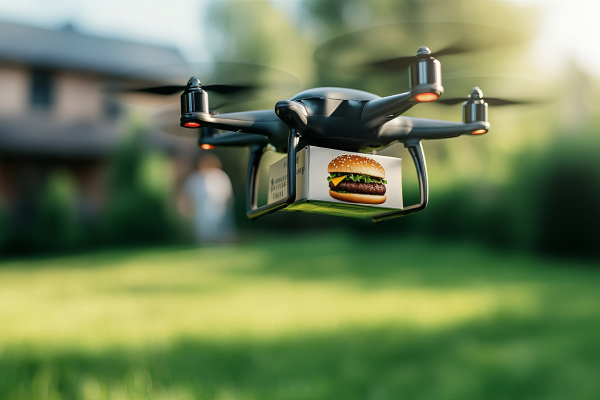
Imagine ordering dinner and watching it descend from the sky. In Ghana, this futuristic vision is inching closer to reality. Drone food delivery, once a sci-fi fantasy, is now being tested and adopted across the globe. From KFC in South Africa to Chick-fil-A in the U.S., drones are changing how food reaches customers. But in emerging markets like Ghana, the story is more complex.
Urban congestion, digital payment systems, and a tech-savvy youth population make Ghana a promising ground for drone delivery. Yet, adoption is not just about infrastructure—it is about people. How do consumers feel about drones? Are they excited or anxious? Will they pay more for the convenience, or shy away due to privacy concerns?
This study dives into those questions, using complexity theory to unpack the tangled web of motivations, emotions, and perceptions that shape consumer behavior. Unlike traditional models that look for linear cause-and-effect, complexity theory embraces the messiness of human decision-making. It recognizes that multiple paths can lead to the same outcome—and that the absence of one factor does not always mean failure.
By surveying over 400 food delivery users in Ghana and analyzing their responses with fsQCA, the researchers uncovered surprising patterns. Some consumers are driven by excitement and novelty. Others are held back by fear and skepticism. And many are influenced by what their peers think.
This is not just a story about drones—it is a story about how technology meets culture, emotion, and trust. As Ghana and other African nations explore drone delivery, understanding these human factors will be key to success.
BEYOND THE BUZZ: WHAT REALLY DRIVES DRONE ADOPTION
Before this study, most research on drone food delivery focused on technical feasibility or isolated psychological factors. Scholars explored perceived usefulness, ease of use, and innovativeness. But these studies often missed the bigger picture—the complex interplay of emotions, social norms, and risk perceptions that shape consumer behavior.
Badu-Baiden and colleagues saw a gap. They wanted to understand not just what drives adoption, but how different factors combine to create distinct consumer profiles. To do this, they turned to complexity theory, which views behavior as the result of multiple interacting forces. It embraces equifinality—the idea that different paths can lead to the same outcome—and causal asymmetry, meaning the same factor can have different effects depending on context.
They also chose fsQCA, a method that identifies combinations of conditions rather than isolated variables. This allowed them to explore how motivation, volition, emotion, and perceived risk interact to influence intention and willingness to pay more.
The researchers proposed three key tenets:
- There is no single optimal configuration for adoption—multiple combinations can work.
- The same factor can play different roles depending on its context.
- At least one of the five categories (motivation, volition, emotion, risk, social influence) must be present in any successful configuration.
This approach moves beyond traditional models like the Technology Acceptance Model (TAM) or Theory of Planned Behavior. It offers a richer, more nuanced understanding of how consumers in emerging markets make decisions about novel technologies.
In Ghana, where drone delivery is still new, this complexity matters. Consumers are navigating unfamiliar territory, balancing excitement with caution. By capturing this dynamic, the study provides a roadmap for understanding—and influencing—consumer behavior in the age of aerial food delivery.
We found that drone delivery adoption is not driven by a single factor, but by emotional, social, and psychological configurations that vary across consumers and contexts.”
INSIDE THE DRONE DECISION LAB
To explore these dynamics, the researchers conducted an online survey in Ghana between April and July 2023. Participants were screened to ensure they had used food delivery services in the past year. Before answering, they watched a short video explaining drone food delivery.
The survey measured five categories of factors: motivation (e.g., usefulness, ease of use), volition (e.g., control), emotion (positive and negative), perceived risk (e.g., privacy, performance), and social influence. Responses were collected from 411 valid participants.
Using fsQCA, the team transformed the data into fuzzy-set scores, allowing them to identify multiple causal configurations. They analyzed which combinations led to high or low intention to use drone delivery and willingness to pay more.
This method allowed them to capture the complexity of consumer behavior, revealing not just what matters—but how it matters in combination with other factors.
MEET THE MODERN GHANAIAN CONSUMER
The study surveyed 411 food delivery users in Ghana, a country with a growing middle-income, tech-savvy population. Most respondents were in their thirties, employed full-time, and had at least an undergraduate education. They used platforms like Bolt Food, Uber Eats, and Yango Deli.
This demographic represents the frontline of digital adoption in Ghana. Their responses offer a window into how emerging market consumers perceive drone technology—not just as a tool, but as a symbol of innovation, status, and convenience.
MULTIPLE PATHS TO YES—AND TO NO
The study identified four distinct configurations leading to high intention to use drone food delivery. Common elements included perceived usefulness, positive attitude, and anticipated positive emotion. Some also featured social norms and ease of use, while others tolerated risks like performance or financial concerns.
Two configurations led to high willingness to pay more, emphasizing motivation, emotion, and social influence. Interestingly, some consumers were willing to pay more despite privacy or financial risks—if emotional and social benefits were strong.
Conversely, negative emotions and perceived risks—especially privacy and social—were strong deterrents. These appeared in configurations linked to low intention and low willingness to pay more.
The takeaway? There’s no one-size-fits-all consumer. Adoption depends on how factors align—and how they resonate emotionally and socially.
EMOTION, TRUST, AND THE SOCIAL SIGNALS OF TECHNOLOGY
According to Badu-Baiden and colleagues, drone delivery is more than logistics—it’s an emotional and social experience. Consumers who feel excited, proud, or happy about drone delivery are more likely to adopt it. These emotions often stem from perceived usefulness and novelty.
But emotions alone aren’t enough. Social norms play a powerful role, especially in Ghana’s collectivist culture. If friends and family support drone delivery, consumers are more likely to follow. If they fear judgment or feel the service clashes with their self-image, they may resist.
Risk perceptions matter—but not equally. Performance and financial risks can be tolerated if benefits are clear. Privacy and social risks, however, are more likely to derail adoption. These concerns tap into deeper fears about control, surveillance, and identity.
The study also highlights causal asymmetry. The same factor—like ease of use—can appear in both high and low adoption scenarios, depending on context. This challenges linear models and calls for a more holistic view.
In short, drone delivery adoption is a dance between excitement and caution, innovation and tradition. Understanding this dance is key to designing services that resonate—not just function.
To win consumer trust, food service providers must design drone delivery experiences that feel exciting, safe, and socially validated—not just fast.”
DESIGNING FOR TRUST AND DELIGHT
For food service providers in emerging markets, this study offers a playbook. First, highlight benefits. Speed, convenience, and novelty are powerful motivators. Use marketing to show real-life scenarios—like solving traffic or reaching remote areas.
Second, build emotional appeal. Consumers want to feel excited, proud, and connected. Use storytelling, social media, and influencers to create buzz.
Third, address risks head-on. Be transparent about data policies and emphasize security. Reassure users about safety and control.
Fourth, leverage social influence. In communities where tech signals status, position drone delivery as premium. Elsewhere, focus on practicality.
Finally, offer flexible pricing. Discounts, trials, or tiered options can ease financial concerns. Show drone delivery is not just futuristic—it’s accessible.
THE NEXT CHAPTER IN AERIAL INNOVATION
Future research could explore actual users versus hypothetical ones, revealing gaps between expectation and reality. Other avenues include technology readiness, cultural influences, and convergence with innovations like AI ordering or smart kitchens.
Expanding to other African nations could offer comparative insights. As drone delivery evolves, understanding the human side remains essential to its success.