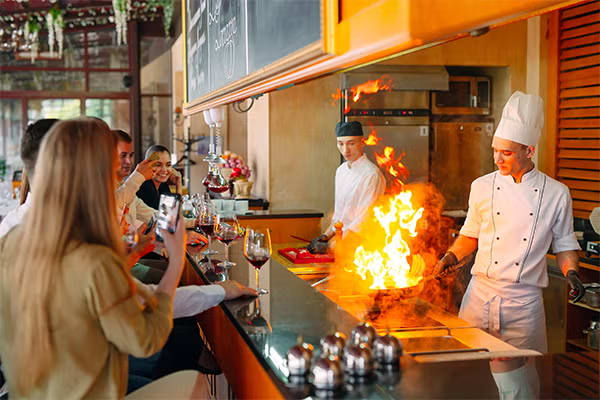
It’s now impossible to eat in a restaurant and not see other diners photographing their food and posting it on social media. ‘Foodstagramming’ has become such a phenomenon that, according to the restaurant rating platform Zagat, 60% of diners regularly indulge in it. Instagram alone received 400 million photographs tagged #food in 2021, making food one of the most common subjects that users post about.
What lies behind this global trend? Despite its prevalence, foodstagramming has attracted little academic attention. Dr. Xiaoxiao Fu at UCF Rosen College of Hospitality Management breaks new ground by looking at foodstagramming from a psychological perspective. Published in the International Journal of Contemporary Hospitality Management, her research reveals how posting images of dining experiences has become a leading way in which individuals present themselves in the online world.
Contextual clues reveal as much about a person as the food. For example, posting an image of several pairs of hands above a sharing plate on a stylish table suggests a close friendship group enjoying an evening out. It portrays the person taking the picture in a positive light and suggests they have a fun life. Alternatively, posting a picture of beautifully prepared and presented Japanese sushi on a simple woven mat hints that the photographer has a clean-living, healthy lifestyle, and an elegant, pared-back esthetic. It also suggests they are open to other cultures and food experiences.
SELF-PRESENTATIONAL BEHAVIOR
Fu investigates what foodstagramming tells us about ‘food experiential value’—the value that individuals place on their consumption experience. This is understood to have both extrinsic value regarding such things as cost, waiting time, and service, and intrinsic value regarding food style, esthetics, and taste.
Using the lens of psychology, Fu also looks at what foodstagramming tells us about the person posting the image. The study is based on strategic self-presentation theory, as developed by Canadian-American sociologist and psychologist Erving Goffman. According to Goffman, individuals adapt the way they present themselves to other people to suit different social situations. The research is equally indebted to Canadian-American psychologist Albert Bandura, who developed social cognitive theory and the concept of self-efficacy. Social cognitive theory proposes that people learn and acquire new behaviors by observing others. Self-efficacy is an individual’s belief that if they act in specific ways they can achieve certain goals.
Fu’s research tests the assumption that in foodstagramming, food experiential value influences self-efficacy and strategic self-presentation, and that this in turn has a positive influence on people’s perceived enjoyment and subsequent behavior.
TOURIST AND RESIDENT DINERS
The study is based on a questionnaire completed by diners who had posted food experience images on social media in the previous 18 months. Around 600 people took part, half of whom posted about a dining experience as a tourist, and half about a dining experience as a neighborhood resident.
A literature review helped identify the measures tested. To probe extrinsic value, for example, participants were asked whether the restaurant service was friendly, and for intrinsic value whether the food was enjoyable. Self-efficacy was probed by asking, for example, whether diners knew how to share photos to present their images well online.
Statements about strategic self-presentation included whether individuals posted about positive experiences. Statements about perceived enjoyment asked, for example, whether they found posting fun. Behavioral intention was probed by asking such things as whether participants would recommend the food experience to others.
Demographic data showed that the tourists and residents in the survey shared a similar profile. Around half identified as male, and the majority of respondents were aged between 30 and 59. In addition, around half had a bachelor’s degree, and annual income was widely spread between less than $15,000 and more than $104,000 a year.
The responses were analyzed using partial least squares structural equation modeling—a statistical technique which examines the inter-relationships between observed and latent variables.
FOOD FOR THOUGHT
The results show that in foodstagramming, the extrinsic and intrinsic value of the food, together with an individual’s feeling of self-efficacy, positively influence strategic self-presentation for both resident and tourist diners. In addition, extrinsic value has a positive effect on self-efficacy for residents, and intrinsic value has a positive effect on self-efficacy for both residents and tourists. Perceived enjoyment and behavioral intention were found to be positively influenced by strategic self-presentation for both resident and tourist diners.
Fu argues that the results support the view that how people feel about themselves can be positively affected and enriched by life experiences, including how they experience food and portray themselves when foodstagramming. This is helped by self-efficacy belief and food experiential value. The fact that self-efficacy was positively influenced by food’s extrinsic value for residents but not for tourists might be because tourist diners expect tourist food experiences to be different and exciting.
According to Fu, the study also highlights the importance of strategic self-presentation, not least that it influences diners’ perceived enjoyment and behavioral intention. Although the results suggest that behavioral intention is not influenced by perceived enjoyment, this may be because foodstagramming is primarily a self-presentational behavior. Furthermore, a successful self-presentational posting may still amount to a recommendation, even if that was not the photographer’s original intention.
Last but not least, the research demonstrates the role of self-efficacy in successful foodstagramming. Diners who are confident in their ability to post positive self-images recognize the value of food experiences as a resource they can use to create a positive impression of themselves online.
FEAST YOUR EYES
Fu’s study has both theoretical implications for the hospitality and tourism literature and practical implications for the hospitality and tourism industry.
The research adds to the social media literature by taking a detailed look at the psychology behind foodstagramming as a strategic self-presentation behavior. Specifically, it shows how diners use photographs of food to portray themselves in a certain manner and promote themselves favorably online.
The study adds to the impression management literature by highlighting the importance of food experiential value and diners’ feelings of self-efficacy, including how they are linked to strategic self-presentation. In addition, it identifies the behavioral outcomes of foodstagramming, including that people who post food images online help to promote food businesses.
As a result, this research also offers practical insights for restaurants, particularly in relation to marketing. For example, it highlights the importance and value of the whole food experience. Fu suggests that restaurants should showcase food styles and local cuisines and consider providing distinctive settings and seating areas with foodstagramming appeal, as well as food that not only tastes good and has a strong story, but also looks good.
As well as inviting diners to post images online, managers could help boost diners’ self-efficacy by helping them to improve their postings, for example, offering workshops on culinary skills and food esthetics. The aim should be to help diners create posts that communicate and promote their personal identities, and at the same time woo new customers for their venue.
Foodstagramming has the potential to become a joint marketing tool which brings personal and business branding together and helps restaurants to expand their online communities. The more foodstagrammers enjoy their food experiences and get satisfaction from using food to boost their personal image, the more recommendations restaurants should receive. Fu’s research should prompt restaurants to rethink the value of their dining experience. As the report concludes, ‘Foodstagramming permits a multidirectional engagement with existing and potential customers, which opens doors for restaurants to participate in a broader marketing network across consumers’ social media sites.’