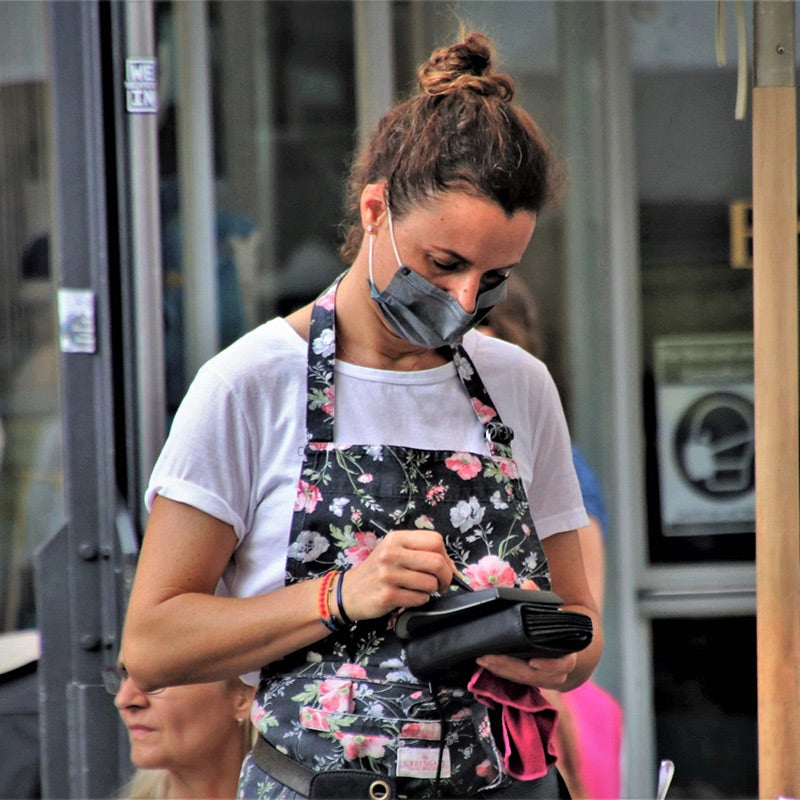
In addition to millions of lives lost, the COVID-19 pandemic has taken a heavy toll on businesses worldwide. The hospitality industry has been one of the hardest hit. In 2020, when restaurants and foodservice establishments had to close or be restricted to take-out, pick-up or delivery only, the National Restaurant Association reported that two-thirds of US restaurant workers—8 million people—lost their jobs through being furloughed or laid-off.
Even when restaurants re-opened in a restricted capacity, many diners stayed away, preferring to stay home to eat, or to eat out less often. As a result, in July 2020 Yelp reported that, of the 26,000 restaurants listed on its website, nearly 16,000 would not be reopening. Employees of the restaurants that did reopen worked in very different, and possibly more stressful circumstances, not least through the risk of exposure to the virus.
We know from the National Institute of Mental Health that one in five Americans live with a mental illness. A recent study found that 80% of hospitality employees believe that mental health issues, for example feeling depressed, anxious or manic, representing a major challenge for the industry. In addition, alcohol and substance use—both of which are known to be a problem in the industry—can be linked to mental health issues. It is also known that high alcohol and substance use can contribute to career dissatisfaction and career turnover.
Researchers at UCF Rosen College of Hospitality Management have carried out the first study of its kind into the effect that COVID-19 has had on restaurant employees. Published in the prestigious International Journal of Hospitality Management, it examines the relationships between restaurant employees’ work status, mental health, substance use, and career turnover intentions during the pandemic. The research has been conducted by Dr. Diego Bufquin, Dr. Jeong-Yeol Park and Dr. Robin Back.
EXPECTATIONS AND HYPOTHESES
A literature review conducted at the beginning of the study informed the 12 hypotheses that Bufquin, Park and Back subsequently investigated. The review identified two markers of mental health: psychological wellbeing and psychological distress. The researchers hypothesized that these would both be affected by work status: that is whether someone is working, furloughed, or has been laid off.
Research also suggested that the restaurant industry has one of the highest rates of illicit drug use and is ranked the third highest for alcohol consumption. It was hypothesized from this that drug and alcohol use would both be affected by work status. In addition it was hypothesized that both drug and alcohol use would decrease with psychological wellbeing and increase with psychological distress. The review found that substance use was a factor that affected career turnover intentions. This gave rise to the separate hypotheses that drug use and alcohol use would increase career turnover intentions. Hospitality is known to be a labour-intensive and stressful industry. Accordingly, the researchers hypothesized that psychological wellbeing would decrease career turnover intention and that psychological distress would increase it.
METHODOLOGY OF THE STUDY
To test their hypotheses, the Rosen researchers compiled a self-reported questionnaire which was sent to non-managerial restaurant employees and former employees who had worked in the industry immediately prior to the pandemic. Participants in the survey, which took place in June 2020, were aged 18 and over, and equally split between people in employed, furloughed, and laid-off work status categories. Some 585 samples were analyzed for the study.
Recognised screening tests were used to measure mental health, drug use, and alcohol use, and career intention was measured according to another respected study. Participants were asked to respond to all questions according to a range of options on a seven-point Likert scale.
Demographic data revealed that 60% of participants identified as male and 40% identified as female. Almost half were aged 18 to 30, and just over half had a four-year college degree. Regarding work status, 40% were still working in the restaurant industry, 35% were laid off and 25% were furloughed.
The study took a two-stage approach to analysis. The validity of the constructs was first tested and confirmed using the multivariate procedure of confirmatory factor analysis (CFA). Structural equation modelling (SEM) was then used to analyse the relationships between the variables measured. SEM is a set of statistical procedures which capture the causal relationships between variables. SEM enables the quantification of behaviour and also accounts for errors in measurement.
INTRIGUING RESULTS
Of the 12 hypotheses identified for Bufquin, Park and Back’s study, three were supported, three were partially supported, and six were not supported. The results indicate that there is no significant influence of work status on psychological wellbeing, though there is some influence of work status on psychological distress. Employees who continued to work through the pandemic reported a significantly higher degree of psychological distress. However, those who were laid off showed no difference in psychological distress compared with those who were furloughed. Employees’ work status was hypothesized to have a significant effect on participants’ use of drugs and alcohol. The results from the study showed that although working employees had a higher tendency to use both drugs and alcohol compared with furloughed staff, there was no significant influence found for laid-off staff when compared with furloughed staff.
Regarding the link between mental health and drug and alcohol use, although the original hypothesis was that psychological wellbeing would decrease drug and alcohol use, the results suggest the opposite. However, it was confirmed that psychological distress significantly increased both drug and alcohol use.
The results did not, as had been anticipated, indicate that career turnover intentions are influenced by drug use, though alcohol use did significantly decrease career turnover intentions. In addition, psychological distress and psychological wellbeing were both found to increase career turnover intentions.
WHAT DOES THIS MEAN?
Given that several of the study’s hypotheses were not supported by the results, COVID-19 appears to have changed the way employees think about work—or the lack of it—and the effect that it has on people’s lives.
Bufquin, Park and Back commented: “Results of this study revealed that work status affects employees’ mental health differently during a pandemic than previously reported in studies conducted prior to the pandemic. More specifically, the current study revealed that employees who were still working during the COVID-19 pandemic experienced higher levels of psychological distress, drug use, and alcohol use than those who had been furloughed. Furthermore, the current study also revealed that psychological wellbeing increases drug and alcohol use, thereby contradicting previous studies.”
The researchers suggest that higher levels of drug and alcohol use and psychological distress experienced by employees who worked during the pandemic could be explained by increasingly stressful working conditions. Employees were required to adapt quickly to challenging new working conditions, and also risked exposure to the virus. A fall in the number of customers also resulted in reduced income, due to the loss of gratuities on which many restaurant workers depend.
While the study did not confirm an association between unemployment and lower psychological wellbeing, the Rosen College research team suggests this might be as a result of the benefits and tax credits that furloughed and laid-off workers received. As a result they were perhaps not as worried about money as their employed former colleagues.
The researchers argue that the fact that a positive link was found between psychological wellbeing and drug and alcohol use could be explained by people having more time on their hands during the pandemic. Increased alcohol sales and alcohol consumption have generally been observed during the pandemic. Other reports have suggested there has been a general increase in substance use, particularly among younger adults, racial/ethnic minorities and essential workers.
MANAGING EMPLOYEES DURING THE PANDEMIC
Bufquin, Park and Back’s study fills a significant gap in the literature and suggests practical ways in which restauranteurs might improve the lives of their employees. They find that restaurant businesses should do more to consider the stresses and strains experienced by employees, and also to prioritize their wellbeing. In particular, they should adopt strategies to mitigate the risks to which employees are exposed, both physically and financially.
For example, partially furloughing employees and having more people working part-time would allow employees to reduce the risk of exposure to the virus, give them more time to recover from the additional strains of working in the pandemic, and allow them to access some unemployment benefits. Restaurant businesses should also coach staff in how to deal with stress, and inform them about external sources of support. In addition, restaurant businesses should consider the impact on employees of having a reduced income because of reduced gratuities.