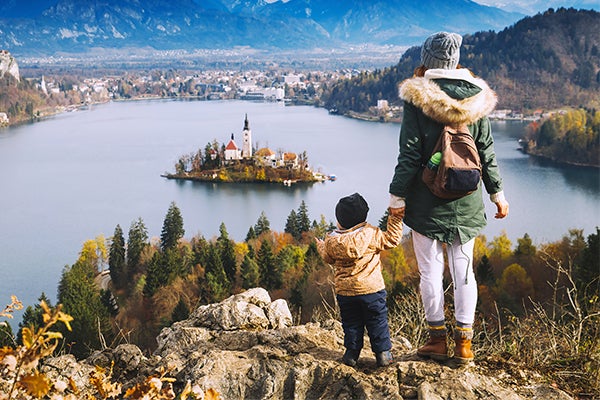
Childhood family holidays, honeymoons, post-retirement adventures … travel experiences are often landmark events in people’s lives. In important new research from UCF Rosen College of Hospitality Management, Associate Professor Xiaoxiao Fu and her collaborators look at how consumption of travel changes with age and how travel fulfils different functions in different life stages. Published in the prestigious journal Tourism Management, the study illustrates, as Dr. Fu and the research team explain, ’how travel is made sense of in the context of life, and how life is made sense of in travel.’
The background to the research is the theory of psychosocial development proposed by Erik Erikson in the 1950s. Influenced by Sigmund Freud, Erikson identified eight stages of human development from infancy to late adulthood. According to his theory, each stage of human development involves a psychological crisis and presents an individual with an existential dilemma. For example, while adolescence is a time when an individual is fundamentally concerned with establishing their identity, middle adulthood is a time when people begin to think about the next generation. Academic literature to date has, for the most part, studied travel experiences as single, isolated incidents in people’s lives. Some studies have looked at such things as the impact of gender/age/marital status on tourism, or how societal forces affect travel patterns, as well as how travel is affected by, for example, advancing age and diminishing health and/or mobility. Others have looked at the transformative nature of travel, such as travelling overseas in a post-college ‘rite of passage.’
Dr. Fu and her collaborators argue that we need a ‘more nuanced understanding’ of the relationship between travel experience and human life. Their research suggests that people’s travel experiences evolve alongside their life stages and that travel and life are interlocked and intertwine, each having a strong impact on the other. The study offers important insights into consumer behavior, and its findings have particular implications for the development and marketing of travel and tourism destinations, facilities, and products.
TIME TO TALK TRAVEL
While the design of the researchers’ study follows Erikson’s theory of psychosocial development, its methodology is based on the sociological theory of social constructionism. Popularized in the 1960s by sociologists such as Peter Berger and Thomas Luckmann, strong constructivism holds that an individual constructs meaning through social interaction, while weak constructivism assumes that individuals construct meaning according to objective facts. As the researchers explain, this study is informed by weak constructivism according to which ‘the facts of the physical world are acknowledged as objective, while the facts of social reality are deemed to be subjectively constructed.’
Taking a longitudinal, biographical approach, participants were asked to look back over their life experience of travel and attribute meaning to their travel consumption at different stages of their lives. In-depth interviews were conducted with 25 participants living in a large metropolitan area in the south-east United States. Interviewees were selected for balance in terms of gender, race, and marital and socio-economic status. The selected age range was people born between 1950 and 1975 to ensure that participants had significant life experience. To minimize the risk of cultural background influencing travel behavior, interviewees were all resident in the United States.
Data were collected by asking participants to draw a timeline of their life history, including important life events such as graduation, marriage, and retirement. They were asked to draw a second line recording their travel experiences in the same chronological order.
Interviewees were then asked to talk about their travel experiences. This included giving details of what motivated individual trips, their destination and duration, who accompanied them, what prompted the vacations, what they meant to them, and whether the trips impacted their life. Interviews were audio-recorded and transcribed. They were then analyzed and coded according to Erikson’s stages of development. As memories of infancy and early childhood were less reliable, the study concentrated on school age, adolescence, young adulthood, adulthood, and maturity.
TRIPS DOWN MEMORY LANE
At school age—the age at which Erikson identifies an individual’s psychological crisis as industry versus inferiority—most interviewees remembered their travel experience as family holidays which created happy memories of being involved in family life. Some reported that financial constraints limited travel to local trips or visiting friends and relatives. The overall experience was associated with gaining competence and agency: for example, one interviewee described the satisfaction of having traveled with her sister, unaccompanied by parents, to stay with their grandmother.
Interviewees reported adolescence as the time they began to take trips without their family, either independently or with friends, reinforcing Erikson’s theory that the dilemma at this life stage is the development of self-identity versus role confusion. Travel became associated with learning and the exploration of new places and situations, as well as awareness of their own individuality. One participant, for example, described the transformative experience of a fine arts summer camp where, for the first time, she met people who shared her passion for music.
According to Erikson, young adulthood presents the challenge of balancing intimacy with isolation, and forming romantic relationships. Participants reported this as an important time of their lives and one in which travel featured prominently, for example relocating for work or travelling abroad for the first time and feeling connected to the wider world. But while one interviewee described a trip with a partner as a ‘symbol of love and union’ and another talked about travel as facilitating intimacy, one participant said that travel highlighted differences between him and his partner in terms of their outlooks on finances.
Interviewees’ comments about travel experiences in adulthood showed awareness of their responsibility to the next generation—what Erikson called the dilemma of generativity versus stagnation. Children and grandchildren featured prominently in participants’ stories, with one speaking about travelling with his children to visit ‘meaningful places’ linked to his family history. Relationship breakdown led to other interviewees talking about travelling to try to rekindle their marriage or causing them to rethink what they wanted from life. In line with Erikson’s view that maturity presents people with the psychological crisis of ego integrity versus despair, participants’ travel experiences at this life stage were associated with reflections on their own life, with its limitations and losses. Some spoke about taking adventurous trips ‘to feel young again’, and one interviewee described taking a cruise in tribute to his late son in order to help him cope with ‘the dead end’ of his own life. Another interviewee said that maturity was the time she could ‘finally travel’, which economic hardship had prevented in her earlier life.
TOURISM PROVIDERS: TAKING LIFE STAGES INTO ACCOUNT
By taking a developmental perspective and looking at travel consumption in the context of consumers’ life stages, the team’s research illustrates the inter-connectedness of travel and life, and how the function and meaning of travel vary enormously at different life stages. The study has important implications for the development and marketing of travel and tourism destinations, facilities, and products. Providing insights into what participants found meaningful about travel at different times should enable tourism providers to develop products and experiences that are tailored towards each age group’s desires and potential life dilemmas. The research is equally helpful for marketing professionals, who could refine messages for existing products, highlighting benefits to attract consumers at specific life stages.
At the level of wider society, participants’ comments about the psychological impact of not being able to travel due to economic hardship, and of travelling after losing loved ones in later life, support arguments that leisure travel could be regarded as a public health resource.
Dr. Fu and her collaborators conclude: ‘This study provides viable suggestions for the tourism industry. The navigation of life stages makes it necessary to design tourism experiences to help resolve stage-specific life dilemmas. The industry should recognize these patterns and changes at various life stages as opportunities for offering resonating experiences, and thus contributing to tourists’ lives beyond a specific trip.’