Storytelling, the sharing of stories and narration of events to others, is a long-standing human practice that facilitates the passing down of knowledge from generation to generation, cultural dissemination, and personal growth. Through storytelling, humans can learn to make sense of the world around them, while also preserving their culture, sense of identity, and personal histories.
Storytelling can also be a valuable resource for research in the field of tourism and travel, as the first-person experiences of travelers can be transformative and highly nuanced. When traveling, people often immerse themselves in the places they are visiting, with this ‘immersion’ leading to powerful and memorable experiences. Drs. Xiaoxiao Fu and Carissa Baker at UCF’s Rosen College of Hospitality Management recently carried out a study exploring the immersion of visitors in Chinese theme parks.
BLOOMING OF THE CHINESE THEME PARK INDUSTRY
Theme parks, such as Disney World and Universal Studios, are very popular tourist destinations, receiving millions of visitors every year. The vast majority of globally renowned theme parks are scattered across the United States and Europe. However, the Chinese theme park industry has seen recent exponential growth, with the country now counting over 100 major parks that are either operating, or under construction. Due to various socioeconomic factors, including the growth of China’s middle class, the theme park industry in China is expected to soon become the largest in the world.
Given its recent onset and expansion, studies exploring the development of China’s theme park market are of key importance. Fu, Baker, and their co-authors set out to explore the intricacies of this emerging sector, particularly focusing on the immersive experiences of tourists visiting Chinese theme parks.
PARKS CENTRED ON CHINESE CULTURE
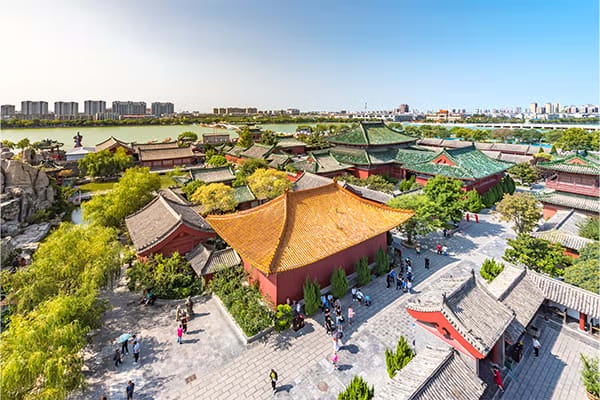
In China, most theme parks are centred around culturally relevant stories, myths, and legends. For instance, at Song Dynasty Town visitors can experience epic stage shows evoking stories that are a crucial part of Chinese heritage, while Sunac and Fantawild parks feature rides and shows closely tied to regional Chinese stories. In contrast to Western theme parks, which are often linked to movies and other intellectual property, Chinese theme parks are more prominently centred around Chinese culture itself. While some intellectual properties can be featured as part of specific shows or rides, they are rarely the central theme of Chinese amusement parks.
So far, studies focusing storytelling in theme parks have been scarce, and existing literature rarely gathered the direct experiences of visitors. Fu, Baker, and their co-authors hoped to address this gap in the literature, unveiling patterns in how theme park visitors immerse themselves in their underlying cultural narratives.
COLLECTING THE STORIES OF VISITORS
To gain insight about how Chinese theme parks immerse visitors in their underlying narratives, the researchers interviewed 30 adults who had visited at least one of China’s culturally themed parks. Their interviews were conducted in Chinese over a period of five months, spanning from December 2020 to April 2021.
As the participants were located in different parts of China, 11 were interviewed in person, while the remaining 19 were contacted via a popular video-conference platform. Each of the interviews was recorded and later transcribed for further analysis.
The most prominent theme parks visited by respondents included Fantawild, Song Dynasty Town, Qingming Riverside Landscape Garden, and Sunac Land. During interviews, participants were asked open-ended, non-leading, and general questions about their subjective experiences with storytelling while visiting these parks, without directly touching on the topic of immersion.
A WIDE RANGE OF EXPERIENCES
The first-person accounts collected by Fu, Baker, and co-authors touched on several aspects of theme park storytelling. Interviewees remembered experiencing a variety of stories inside the parks, which were rooted in different themes or ‘genres’, including romantic, historial, mythical, and fairy-tales. Stories could be conveyed through a variety of attractions, including stage shows or performances, horror/thrill rides, and suggestive environments designed to be explored on foot. The researchers found that some visitors were drawn to stories that they had already encountered in the past, while others preferred to be surprised by unfamiliar narratives.
Although the interviewees did not always feel immersed in the stories presented in theme parks, reports of instances when they did appeared to follow a similar pattern. By analyzing accounts of immersion during particular rides, shows, or walk-through attractions, the researchers were able to identify four primary dimensions or stages of immersion in Chinese theme park experiences.
THE DIFFERENT DIMENSIONS OF IMMERSION
The first dimension uncovered by the researchers, named ‘spatial-temporal immersion’, entails a sense of presence and engagement with the surrounding environment. This could be elicited by movie-like settings, the realistic recreation of historical settings, and other scenographic elements.
The second dimension is closely linked to sensory experiences. This dimension is unlocked via striking visual effects, such as changes in lighting, as well as auditory stimuli, which could include effective musical choices, recognizable soundtracks, and terrorizing or evocative sounds, for example. These sensory elements can be further enhanced using holographic 3D and 5D projections, or other technology-fueled special effects.
The next stage of immersion incorporates conceptual and imaginative elements, encouraging visitors to mentally engage with a narrated story. Visitor accounts of conceptual-imaginative immersion mentioned that they had lost track of time, felt detached from reality or had forgotten where they were—they were so enraptured with the story. This dimension of immersion could be facilitated by several factors, including skilful presentations of both old and unfamiliar stories, convincing acting, and moments in which visitors could interact with a given story.
The fourth and final dimension identified by Fu, Baker, and co-authors is what they refer to as emotional immersion. This occurs when visitors feel emotionally touched by a narrative, feeling overjoyed, shedding a tear, or even identifying themselves with the characters. Whether via the convincing performance of a tumultuous romantic story or the display of other forms of human suffering that elicited feelings of empathy, this dimension of immersion was shown to make a theme park visitor’s experiences particularly meaningful and memorable.
The researchers also tried to better understand instances in which visitors had not felt immersed. They found that many study participants reported feeling immersed physically or via the senses during theme park attractions, but not mentally or emotionally. The most commonly reported factors lowering engagement included a lack of personal interest in a story, a perceived lack of authenticity, little or no interactive elements, a disconnection between stories presented as part of the same ride or performance, a general lack of story, too much information presented at once, or immature characters that they could not identify with.
A FRAMEWORK SUMMARIZING THEME PARK IMMERSION
Building on their analyses, the researchers derived a new conceptual framework that outlines elements of storytelling-based immersive experiences in theme parks. This framework describes the process through which theme park visitors become immersed in specific attractions, delineating the different dimensions of immersion and exploring their coexistence.
Fu, Baker, and colleagues suggest that these stages of immersion do not necessarily occur in a linear or ordered sequence. In fact, some of them might not be experienced at all. Their framework depicts immersion as a meaning-making process that encourages those visiting theme parks to make sense of what they experience and treasure the most salient moments of their visit. While spatio-temporal immersion is the most immediate form of immersion, the researchers suggest that it might not necessarily be the most incisive, as emotional and conceptual-imaginative immersion appeared to be most closely associated with participants’ most positive recollections.
The recent work by Fu, Baker, and co-authors gathered invaluable insight about factors that can contribute to making theme park experiences desirable, unforgettable, and deeply enchanting. Their conceptual framework and analysis of real-world visitor accounts could soon serve as a guide for the creation of new powerful theme park attractions likely to attract a vast number of tourists.