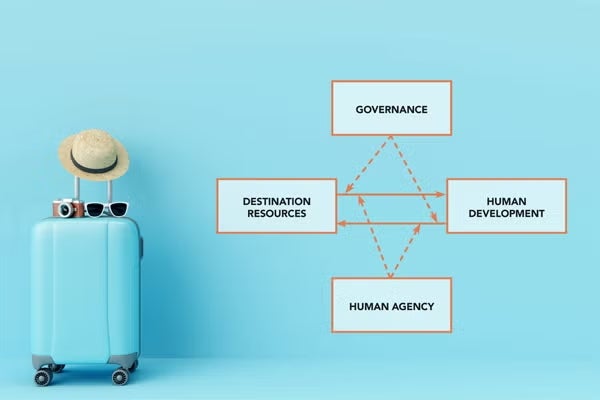
Destination competitiveness can promote tourism demand and create memorable experiences for tourists. These experiences may then trigger higher consumption which generates more occupational opportunities for local residents. And since income is fundamental for achieving freedom, this can impact human development and enhance the quality of life for locals.
Viewed through this lens, tourism performance is critical for destinations and government officials when it comes to garnering residents’ support for related development. This support hinges on the perceived benefits of tourism. However, these benefits may not reach all residents because of various factors including social arrangement, unemployment, and lack of financial credit, and human agency in the form of individual and collective action to demand a say in decision-making processes.
A study by Professor Robertico Croes and Associate Professor Jorge Ridderstaat from the UCF Rosen College of Hospitality Management delves into this complex relationship to uncover how capabilities and context can influence the relationship between competitiveness and human development. Research is highly important in this sector because the ways in which tourism is governed and how human agency is employed may benefit or impede how local residents live their lives. It could, for example, create more job opportunities for women that could then lead to more empowerment to demand their rights.
DEFINING DESTINATION COMPETITIVENESS
The challenge to define the concept of destination competitiveness lies in its multidimensionality and the array of factors that influence it. Past studies argue that characterization relies on comparative and competitive advantages, but over time, that definition has evolved to market share-oriented and, more recently, sustainability-oriented.
With no universal definition available, Croes and Ridderstaat define destination competitiveness as a set of resources that can provide memorable experiences for tourists, promote demand, and enhance quality of life. This echoes the destination competitiveness theory, which unifies competitiveness with human development. Essentially, competitiveness provides the resources that can enlarge residents’ choices and social connectedness.
A FOCUS ON HUMAN DEVELOPMENT
Human development includes and enhances health, education, and skills that are essential for destination competitiveness. However, little is currently known about these influences, their nature, or their potential in relation to destination competitiveness.
The shift to focusing on human development resulted from the disappointment of conceptualizing wellbeing as a reflection of material possessions, and the disillusionment with the existing gap between economic growth and improvements in the quality of life of many people. A capability approach instead proposes that progress and development should enhance people’s choices and opportunities, and shifts focus from production and economic growth to people as individuals and life’s intrinsic values.
This framework has three pillars: capabilities, functioning, and freedom to choose and seize opportunities. Capabilities covers fundamental freedoms such as being able to vote, study, and belong, and functioning refers to what people do and who they are, such as having a job and being healthy.
THE ROLE OF AGENCY
How these capabilities convert into functioning depends on agency, which refers to a person’s ability to seize opportunities to improve their life conditions.
This is heavily dependent on social, economic, and cultural context, as well as individual characteristics including intelligence, gender, and disabilities, and social factors such as legal frameworks and population density. Environmental considerations like geographical conditions and pollution also play a part.
When combined, these conversion factors evaluate the human development outcomes that can be triggered by resources stemming from destination competitiveness.
REDEFINING THE EVALUATIVE BASIS
The capability approach used by Croes and Ridderstaat in this study also redefines the evaluative basis for assessing people and development. In this approach, the focus moves away from economic performance and instead embeds itself in the potential for tangible improvements in human lives.
This approach is reflected in the United Nations Development Program’s (UNDP) Human Development Index (HDI), which is an alternative to gross domestic product (GDP) for measuring human achievements.
THE ROLE OF GOVERNANCE AND AGENCY
In contrast to the majority of existing tourism studies, Croes and Ridderstaat have integrated governance and agency as relevant conversion factors to examine the relationship between destination competitiveness and human development.
Tourism plays a leading role in economic development for many destinations and is a notable contributor to GDP. Tourism also contributes to job creation both directly and indirectly, promotes entrepreneurship, and, for many developing economies, provides a primary source of foreign currency income. However, until recently, the critical role of government and its influence on destination competitiveness, an individual’s capabilities, and the quality of life that a person can choose has often been overlooked.
A FRAGMENTED INDUSTRY
The tourism industry is unique in that almost 80% of it comprises micro-, small-, and medium-sized enterprises. This fragmented nature means that the government is the sole entity with the power to implement the consistent, long-term policies needed for tourism to thrive.
Tourism is also more susceptible to market failure and distortion than other industries, which makes government involvement even more necessary. This should be actualized in new and renewed destinations by providing infrastructure and facilities, promoting sustainable development, maximizing social welfare, and protecting public interest.
A CASE STUDY IN MALAYSIA
Malaysia was chosen as a case study because of its unique standing in the global tourism industry. This Southeast Asian nation has a multi-ethnic population and elected monarchy and is an important economic and trade link in the region. Malaysia has successfully transformed itself from a producer of raw materials to an upper-middle-income country and growing tech hub. The country’s tourism industry is on the rise and in 2019, it accounted for 13.3% of the GDP with 26 million arrivals during that year alone.
In their research, Croes and Ridderstaat examined the interactions between destination competitiveness and human development and explored whether governance and human agency play a part in shaping their relationship. The study argues that destination competitiveness is, in fact, intrinsically linked to human development and that the two are mutually dependent.
EMPOWERING RESIDENTS THROUGH OPPORTUNITIES
The theoretical implications of this study suggest that destination competitiveness and human development can be mutually reinforcing in upper-middle-income countries, and that human agency supersedes governance regarding tourism-related public resource allocation choices. Additionally, results identify that it is critical to empower residents through occupational opportunities for the benefit of reinforcing the link between destination competitiveness and human development. It also revealed that, surprisingly, there is a lack of governance in the relationship between destination competitiveness and human development.
This research points to the idea that the promotion of tourism through higher spending could generate the necessary resources and opportunities needed for sustained human development. However, it is imperative to ensure that resources and opportunities resulting from tourism promotion are effectively allocated to improve public resources, tourist infrastructure, hygiene and public health, and public areas and facilities.
Destination managers should be honest and transparent about the real economic, social, and environmental costs of tourism and develop country-specific plans and programs to tackle these problems.
FOUNDATIONS FOR FURTHER RESEARCH
Findings from this study support three requisites: empowering people through occupational opportunities, promoting tourism toward sustaining human development, and placing agency over governance regarding public resource allocation.
For Malaysia specifically, this means that improving its brand image on these issues is crucial. However, Croes and Ridderstaat warn against blindly applying best practices and instead factoring in human diversity and country-specific circumstances.
This research sets the stage for further investigations focusing on urban versus rural destinations and exploring gender roles to develop a better understanding of the nature and impact of such relationships.