WHAT DRIVES ME EVERY DAY
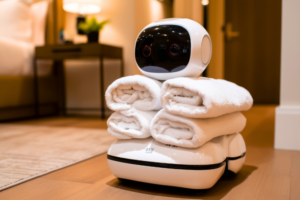
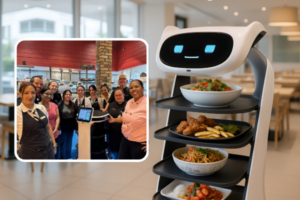
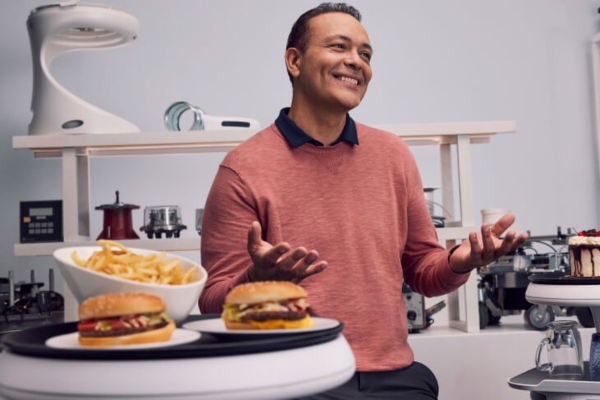
I’m Juan Higueros, Co-Founder and Chief Operating Officer of Bear Robotics. My path has taken me from strategy and M&A at KPMG to corporate development at Polycom, grounded by a B.A. in Economics from UCLA and an M.B.A. from MIT Sloan. At Bear Robotics, we’ve focused on building AI-driven service robots that can run food and bus tables, not to replace people, but to ease the most repetitive and physically punishing tasks so teams can deliver the kind of care that defines hospitality. For me, technology should quietly empower the human side of service. That’s the vision I carry into every decision: keep dignity intact, reduce friction, and protect the moments of connection that matter most.
We build tools that strip away friction and heavy lifting so people have the time and energy for the human work: empathy, storytelling, and connection. That’s where great service—and real care—actually live.”
ORIGINS AND VISION: WHY I STARTED, WHAT I SEE
I still carry the memory of one early night with our first prototype in our co-founder’s own restaurant. We were short-staffed, and a cook who was also running food broke down before her shift. Her back pain was severe, but she couldn’t take time off. She needed to send money home for her father’s funeral in Guatemala—a funeral she couldn’t afford to attend. For me, that moment crystallized what was broken: the people carrying hospitality on their shoulders were suffering, and the system wasn’t built to support them.
From the start, I didn’t see Bear Robotics as “building robots for the sake of it.” I saw us building tools to remove the most repetitive, physically punishing tasks so people could focus on the part of hospitality that really matters: caring and service for guests. That vision hasn’t changed; if anything, it’s expanded. Today, I see robots as a natural extension of the service team, helping businesses run smoothly and giving workers back essential breathing room.
I believe hospitality is defined by its human touch. Robots don’t ruin hospitality—bad service does. Our job is to strip away friction so humanity has space to breathe. When servers aren’t carrying forty-pound trays back and forth all night, they can spend more time connecting with guests. In my view, robots take the labor out of labor so people can do what they do best: empathy, storytelling, and connection. That’s the heart of why we started and the anchor of what we still see ahead.
For me, robots don’t ruin hospitality—bad service does.”
WORKFORCE AND SERVICE CULTURE: HIGH TECH, HIGH TOUCH
I hear the same refrain across the U.S.: “I can’t find enough staff to even open my dining room.” For me, robots help keep the doors open, but more importantly, they protect workers from burnout. When you pull the most grueling, repetitive tasks out of a shift, you free people to step into higher-value roles—from shaping guest experiences to training teams. I don’t see that as job loss; I see that as career growth.
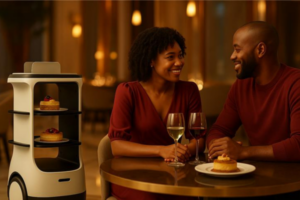
“High tech, high touch” only works when design is intentional. I believe technology should fade into the background and make people more present, not less. If a robot silently clears tables, a server can be fully with a guest who just went through a breakup for five more minutes. To me, that’s technology amplifying human touch, not replacing it. The goal is to create space—space for empathy, for listening, for the little gestures that turn service into care.
My experience has taught me that when we design with empathy, we reinforce dignity. Robots aren’t coming for people’s jobs; they’re coming for the strain and the grind that push people to the edge. I see a workforce culture where technology carries the heavy load and people carry the heart of hospitality. That’s how “high tech, high touch” becomes a lived reality on the floor.
When robots carry the grind and humans carry the heart, we protect dignity, reduce burnout, and create the space for hospitality’s most essential moments of connection.”
DESIGN AND GLOBAL PERSPECTIVES: MAKING ROBOTS PART OF THE TEAM
At Bear Robotics, we design robots as if they’re teammates. For me, that means they must be intuitive, approachable, and simple to use. When a guest sees a robot gliding by, I want it to feel like part of the restaurant’s natural flow—not a disruption. And for employees, my threshold is straightforward: after five minutes, do they feel like the robot is just another teammate helping them get through the rush? If the answer is yes, then I believe we did our job.
Across markets, motivations differ, and we pay attention to those contrasts. In the U.S., the conversation often begins with labor shortages. I remember a hospitality customer telling us, “Anything that helps our servers move things along is a good thing; happier servers make better service.” That’s the lens here: survival and retention. In Asia, the shortages exist too—especially with efficiency. Robots are welcomed because they deliver precision and consistency.
What matters to me is the outcome, which is remarkably similar across cultures: robots aren’t about replacing people; they’re about enabling better experiences for everyone. I see thoughtful design as the bridge—making robots feel like part of the team so guests experience ease, employees feel supported, and operators see smoother service. When that happens, culture and technology meet where hospitality lives.
LEADERSHIP AND CROSS-SECTOR LESSONS: TRUSTING CHANGE
I’ve learned that transparency and trust are everything when leaders introduce robotics. If people think robots are coming for their jobs, fear sets in quickly. For me, effective leadership frames technology as a partner, not a threat. The organizations I’ve seen succeed communicate early, train thoroughly, and let staff experience firsthand that robots are there to help, not replace. When people see the daily reality—less strain, more support—trust begins to grow.
I also borrow perspectives from other industries. In healthcare, robots deliver medicine, but no one calls them “nurses.” In logistics, robots move pallets, but they’re not “workers.” Hospitality can adopt the same mindset. I believe robots should do the heavy lifting so people can do the connecting and creating. The industries that thrive are the ones that clearly separate the mechanical from the human—and then integrate them seamlessly.
That separation, followed by thoughtful integration, is how I’ve seen fear turn into confidence. Leaders who guide change this way create cultures where technology feels like an ally. To me, that’s the difference between disruption that erodes morale and innovation that elevates the human experience.
EDUCATION AND THE FUTURE: PREPARING LEADERS FOR “HUMANS + ROBOTS”
I don’t believe future leaders have to choose between people and technology; their job will be to integrate both. What matters to me is building a skill set that spans guest psychology and system design. I want leaders with empathy to guide teams and with technical literacy to evaluate tools. Above all, I value the courage to embrace change rather than fear it.
Looking ten years ahead, I see every hospitality team including both humans and robots, and the best leaders orchestrating both. Just as no hotel operates without a reservation system today, I believe no restaurant will operate without robotic support. For higher education, that means training leaders who view technology not as optional but as core infrastructure. For industry, it means starting now: experiment, iterate, and involve employees in shaping how robots are integrated.
I see the future not as man or machine but both, working together. If we teach and lead with that understanding, we’ll keep hospitality’s human essence intact while giving teams the tools to thrive.
I don’t ask teams to choose between people and technology; I ask them to orchestrate both.”
FOR ME, THE FUTURE IS HUMAN + ROBOT
Looking ahead, I see hospitality where humans and robots work in concert. Robots will handle the heavy lifting and repetitive strain; people will create the moments that matter. My commitment is to design with empathy, lead with transparency, and educate with foresight so technology stays in service of humanity. I believe tomorrow’s hospitality will feel more personal, not less, because teams will have the breathing room to be present. If we keep integrating thoughtfully—experimenting, iterating, and inviting employees into the process—we’ll build operations that are resilient and human-centered. For me, that’s the purpose: give people the tools to thrive, and let hospitality be the care we share.
I see a future where technology elevates hospitality. With empathy and courageous design, robots become partners—not replacements—helping us create experiences that feel more human, meaningful, and connected.”