When great disasters strike there is no time to plan an instant response; those who can mitigate the damage and recover fastest are those who already have relevant contingency plans in place.
Between 2002 and 2006, the world experienced its first major exposure to the SARS (severe acute respiratory syndrome) virus which infected 8,096 people and claimed 774 lives across some 25 countries. Although many business sectors were affected, the ‘non-essential’ sectors of travel, food service, and leisure felt the dual impact of enforced closure and consumers’ unwillingness to risk possible infection. This novel paper from Dr. Elizabeth Yost, Dr. Murat Kizildag and Dr. Jorge Ridderstaat, focuses on the lessons learned for the restaurant sector, identifying strategies for both survival and recovery. The paper then considers the practical application of these strategies, exploring the leading full-service restaurant company in the U.S., Darden Restaurants, as a case study of survival and revival as the pandemic’s impact begins to decrease.
A VULNERABLE SECTOR
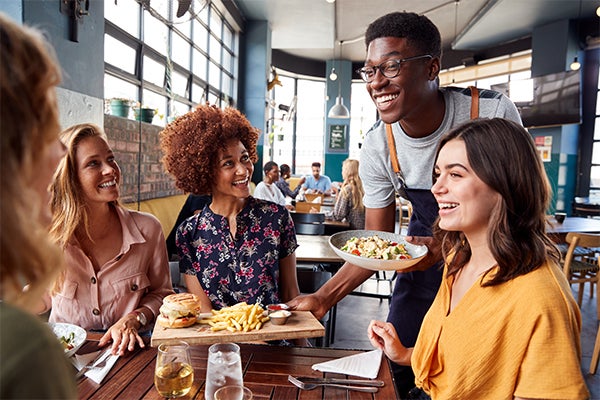
As identified by the researchers, the restaurant sector was, perhaps, impacted more quickly and dramatically than many others. The lockdowns of early 2020 used legislation to close restaurant doors, but the ongoing fear of the virus has continued to slow the influx of diners, even as restaurants open their doors again.
Eating out, especially in the full-service restaurant sector, is not an essential activity, and for many people it can easily be postponed to safer times. For the restaurants though, the longer the customers stay away, the less positive the prognosis for the business.
Many restaurants will never reopen; whole chains have gone to the wall, their cash reserves exhausted and the future too uncertain to buy time through additional borrowing or by attracting emergency investment. But many have survived and, some will argue, will emerge from this pandemic leaner and even more resilient than before.
A CASE STUDY: DARDEN RESTAURANTS
Darden Restaurants is one of those. Parent company to a host of iconic U.S. brands, such as Olive Garden Italian Kitchen, Longhorn Steakhouse, Eddie Vis Prime Seafood, and many more, there must be very few Americans who do not know or frequent at least one local Darden restaurant.
The research team posed a number of open-ended questions to the Darden executives, covering broad operational issues together with specific financial strategies. In their paper, the Rosen College research team discuss the insights gained from these interviews to identify the financial strategies that have firstly enabled survival and, secondly, resulted in a rapid return to positive financial performance as lockdown has eased across the U.S. The researchers from Rosen College contend that an inductive approach to a single company case study, taking a results-driven approach to assessing financial strategy, will provide more robust and rich ideas for the industry as a whole.
DARDEN: SIMPLY BETTER THAN THE REST?
So, did Darden Restaurants emerge from the pandemic bruised, but far from beaten, simply because of its size? Not according to the Darden executives and the Rosen College researchers. In fact, its sheer size and geographic spread throughout the U.S. meant that it was particularly vulnerable to state-by-state and district-by-district lockdown variations.
Did Darden survive the pandemic because it had enough cash reserves to keep itself afloat? Well, the company does have deep pockets, but that is because strong liquidity has always been at the heart of its contingency planning, as well as its growth planning.
Did Darden survive by brutally cutting all costs? Although the company closed 1,800 dining rooms which impacted the lives of 150,000 employees, looking after their people has been another cornerstone of strategy across all the Darden brands. When the restaurants were forced to close, the staff were viewed as investments that needed the same careful management as all other assets.
KEEPING THE CASH FLOWING
One of the key strategies for dealing with the closure of dining rooms is to put all expansion and avoidable refurbishment capital investment on hold. Additionally, advertising and marketing spend should be cut dramatically as there is little point in huge marketing expenditure when the market is neither allowed nor inclined to dine out.
In order to regain valuable revenue, restaurants could focus on the take-out market. Darden managed this by increasing marketing spend for these services and extending it to include a ‘butcher shop of raw meats and goods’ for home preparation.
But there are very few industries where total costs and sales are in direct proportion, and the restaurant business is certainly not one of them. Sales may drop dramatically, but overheads and financial commitments do not stop, so more decisive action usually is required.
The next survival strategy that Darden adopted was negotiating with suppliers for more favorable terms. This reduced purchasing costs and/or extended payment terms; potentially this was easier for a company the scale of Darden, but not impossible for even single unit operations showing a proactive approach to the challenges.
One major cost that must be addressed in such uncertain times is the staff and support employees. The approach that Darden took was influenced by their core values that all employees be treated with fairness. Initially the company reduced the immediate negative effects by paying emergency sick pay for two weeks to hourly paid workers in the disrupted restaurants and put in place furlough arrangements throughout the hierarchy. In order to maintain staff loyalty, senior executives took a 50% pay cut and the CEO voluntarily sacrificed his entire salary entitlement.
PLANNING FOR THE RECOVERY PHASE
Although many restaurants would be tempted simply to buckle down and try to weather the storm, one of the strategies that allowed Darden to thrive throughout the pandemic was its ability to plan for the future, a lesson that other companies should follow.
When interviewed by the Rosen College researchers, the Darden executives revealed that they initially secured liquidity with a loan and a public offering. Then they focused on forecasting, as a more optimistic forecast of cash flow allowed Darden to repay its credit but retain access to it if another lockdown made it necessary.
Understanding the business’ historical operating costs is also one of the methods that Darden modelled, enabling the company to produce a leaner financial management model as the restaurant sector began to recover post-COVID.
Additionally, the paper recognizes that poor menu planning can lead to inefficiencies in purchasing, storage and preparation, and service. Focus on this aspect was able to reduce costs for operations which continued to trade through the pandemic and has become a key part of the strategy for recovery and on into the, hopefully, brighter future.
NEW CHALLENGES
The ‘unlocking’ phase was complicated by the somewhat variable decisions of local regulators and a whole host of new challenges faced the industry after lockdown started to ease.
First among these was enticing customers back into the newly reopened restaurants against a continuing backdrop of uncertainty. Many were suffering ‘cabin fever’ effects of enforced isolation so took the first opportunities to restart their social lives, but others were far more uncertain and needed considerable persuasion.
In order to encourage reluctant diners, Darden Restaurants employed a number of strategies to overcome their reservations. Marketing campaigns highlighted the safety precautions being taken in their restaurants, including the limits on seating capacity to enable social distancing, and the increased hygiene protocols.
The next challenge was to continue return momentum, once the customers started dining out again. Darden handled this by emphasizing food quality and variety during the menu planning operation, making the dining out option even more attractive. This was further supported by pricing initiatives to encourage repeat custom.
The researchers discovered that one of the key factors to survival was the retention of employees; Darden had managed this by retaining the loyalty of their key staff members by proving their commitment to treating their employees fairly despite the difficulties posed by COVID-19.
CONCLUSION
The researchers identified that a strong balance sheet and a rapid response to emerging realities are critical to surviving such business ‘shocks’ as the pandemic. Darden Restaurants’ story of the past two years has shown that much can be done to mitigate damage and be ready for recovery.
The company’s early return to a positive cash flow, together with a more profitable business model going forward, should be evidence that all restaurant businesses should be working towards the best, but also ready for the worst—if, when, and in whatever form, it comes.